
The Ultimate Test: Can You Mix the Rules? 🧪
Welcome to Lesson 9. This is the most exciting part of Noorani Qaida so far! You are no longer just practicing sounds; you are reading real Quranic words.
In this lesson, we mix everything: Tanween (The Ring), Madd (The Stretch), and Lin (The Softness). Plus, we will meet a new friend: The Wave (~) which means “Super Stretch”!
Your goal is to switch smoothly between short vowels (1 count), natural stretch (2 counts), and long stretch (4 counts) without stumbling.
Let’s prove your mastery! 👇
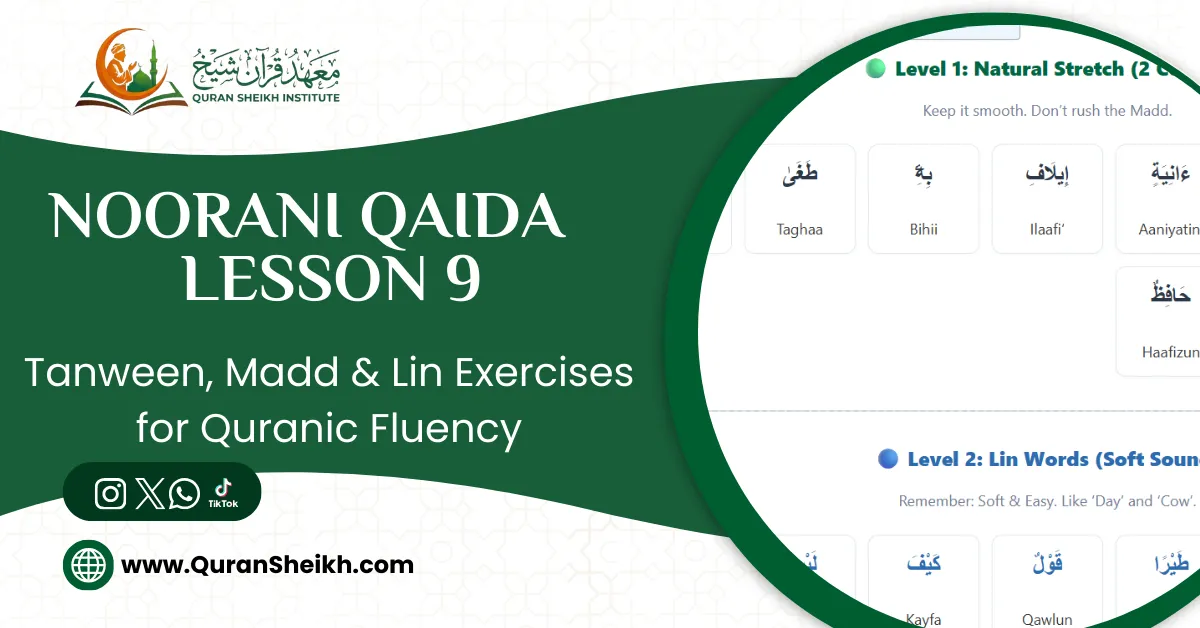
‘Aamana
‘Aawa
‘Aaniyatin
‘Ilaafi
Bihii
Taghaa
‘Alaa
Yarahuu
Haasidin
Haafizun
🔵 Level 2: Lin Words (Soft Sound)
Remember: Soft & Easy. Like ‘Day’ and ‘Cow’.
‘Ayna
Khawfin
Tayran
Qawlun
Kayfa
Laysa
Yawmin
Qurayshin
Sayfi
Bayti
🔴 Level 3: The Big Wave (4-5 Counts)
See the Wave (~)? Stretch it Loooong!
Jaaaa’a
Jieeee’a
Shaaaa’a
Suuuu’a
Sieee’at
Maaaa’in
Ghuthaaaa’an
Jazaaaa’u
📺 Watch the Full Lesson: Listen & Repeat

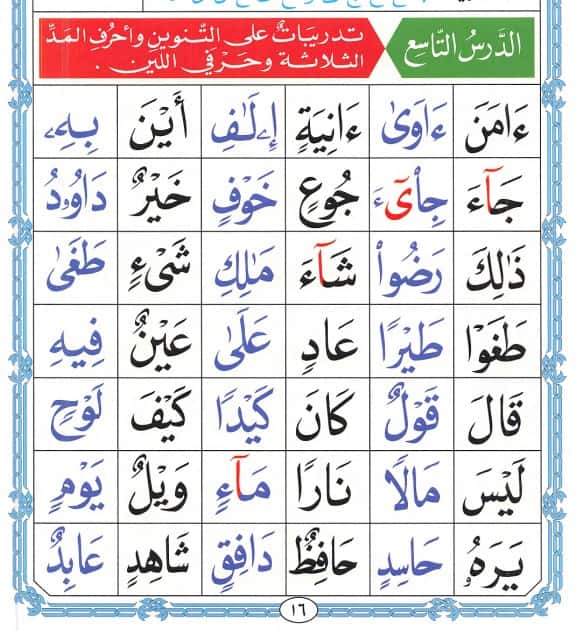
🧬 New Rule: The “Wave” (Madd Muttasil)
What happens when a Madd Letter meets a Hamza?
Madd Letter + Hamza = Extra Stretch
In this lesson, you will see words like ( جَآءَ ). Notice the wave symbol (~) on top?
This happens because a Hamza (ء) comes directly after a Madd letter in the same word.
💡 Golden Tips for Lesson 9
1. Spot the Hamza! 👁️
If you see a Hamza (ء) after an Alif, Waw, or Ya, get ready to STRETCH. Don’t treat it like a normal 2-count Madd.
2. The “Tanween” Brake 🛑
When stopping on a word with Tanween (like Khawfin), we usually ignore the Tanween sound. But if you are continuing, you MUST pronounce the ‘N’ sound clearly: Khawfin…
3. Don’t Bounce the Lin
When reading Lin words like Bayt, keep the sound smooth. Don’t let it bounce (Qalqalah) or cut off abruptly.
📥 Take the Classroom Home
Download the Complete Noorani Qaida PDF (Free)
Don’t let the learning stop here. Get the exact book used by our Sheikhs. High-quality, clear script, and perfect for offline practice on any device.
- ✅ Crystal Clear Arabic Script
- ✅ Compatible with Mobile & Tablet
- ✅ 100% Free for Students
File size: Lightweight & Fast (PDF)
🎓 For Teachers: Diagnostic Checks
1. Testing “Madd” Timing
2. The “Standing Fatha” Confusion
🧠 How to Spell Like a Pro (Hijjaa Method)
Example 1: ( بَا )
1. Say Letter Name: “Baa”
2. Say Vowel Name: “Fatha”
3. Say Madd Letter: “Alif”
4. Combine: “Baa Fatha Alif -> Baaa” (Stretch 2 sec)
Example 2: ( خَوْ )
1. Say Letter Name: “Khaa”
2. Say Vowel Name: “Fatha”
3. Say Lin Letter: “Waw Sukoon”
4. Combine: “Khaa Fatha Waw -> Khau” (Softly)
Master the Art of Quran Recitation
Don’t rely on self-study alone. Get your pronunciation checked by a certified Al-Azhar Sheikh today.
- ✨ 1-on-1 Live Private Session
- ✨ Native Arab Tutors (Male & Female)
- ✨ 100% Free Evaluation – No Commitment
🔒 No Credit Card Required
💬 Common Questions About Lesson 9
Master the tricky rules of Tanween, Madd, and Lin.
How do I read words with both Madd and Tanween?
Break it down! First, stretch the Madd letter (2 counts). Then, pronounce the Tanween (N sound) clearly.
Example: عَـذَابٌ = ‘A-thaaa (stretch) – bun (ring).
What does the wave symbol (~) mean?
This symbol indicates Madd Zaid (Extra Stretch). It appears when a Madd letter meets a Hamza. You must stretch the sound for 4 to 5 counts (double the normal stretch). Example: جَآءَ.
Why is the word (أَنَا) tricky in this lesson?
Because of the Silent Alif rule. Even though you see an Alif at the end, the small circle tells you NOT to stretch it when continuing. Read it short: “Ana”, not “Anaaa”.
How do I know if (و) is a Madd or Lin letter?
Look at the vowel before it:
If it has Damma (ـُ و), it’s Madd (Stretch: “uu”).
If it has Fatha (ـَ و), it’s Lin (Soft: “au”).
What is the small Ya in words like (بِهِۦ)?
This is Madd Silah Sagheera. It connects the pronoun “Hi” with a long “ee” sound (2 counts) if you don’t stop. Read it as “Bi-hiii”.
Is (خَيْرٌ) read with a stretch?
No. The Ya here is a Lin letter (preceded by Fatha). Pronounce it softly like “Khay” (as in ‘Hay’), then add the Tanween: “Khay-run”. Do not stretch it like “Khaaa-run”.
Why do some words end with Alif but have Tanween (ـً)?
This happens with Fathatain (Double Fatha). The Alif is usually silent when you continue reading (you just say the ‘an’ sound). But if you STOP, you drop the ‘n’ and pronounce the Alif as a stretch (Madd Iwad).
You Are a Reader! 🌟
By finishing Lesson 9, you have proven you can handle complex words with multiple rules. You are now ready for the “Silent Letters” rules!
Want to see the full roadmap?
Access the complete Noorani Qaida Syllabus (All 17 Lessons)
🎓 Ready to Level Up?
Don’t just read alone. Join our live classes with expert Sheikhs.


