
The First Big Test: Can You Connect the Dots? 🧩
Welcome to Lesson 6. This is not just a new lesson; it’s a Celebration of what you’ve learned! Here, we combine the “Movements” (Harakat) from Lesson 4 with the “Ringtone” (Tanween) from Lesson 5.
Your Goal: To read complete words, not just letters. This is where your recitation starts to flow.
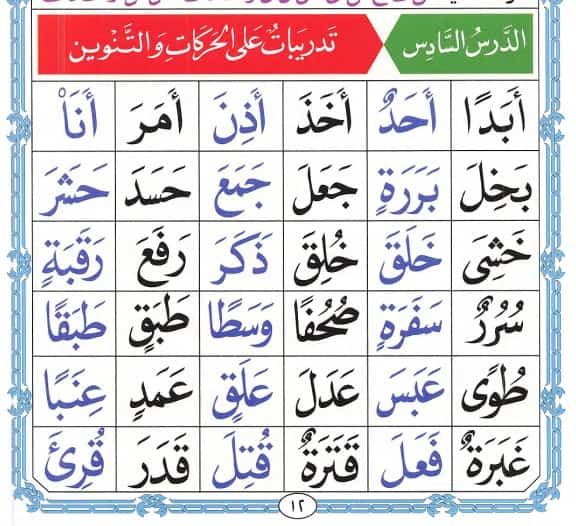
Example: ( أَبَدًا ) = A (Fatha) + Ba (Fatha) + Dan (Tanween).
Ready to read your first real Arabic words? Let’s dive in! 👇
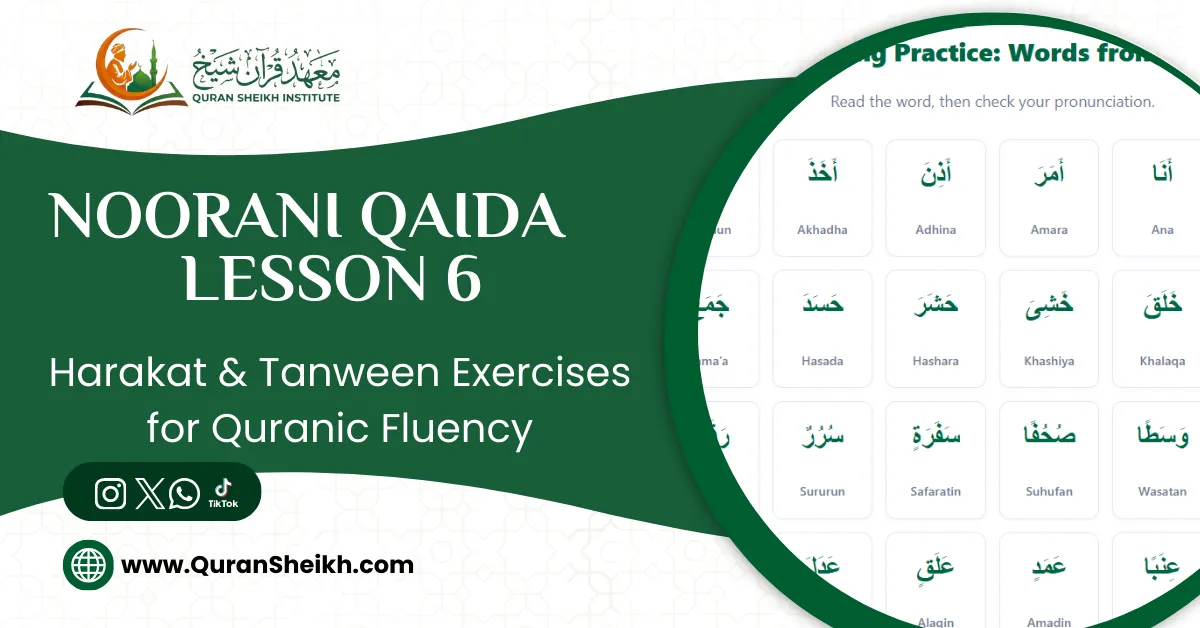
Abadan
Ahadun
Akhadha
Adhina
Amara
Ana
Bakhila
Bararatin
Ja’ala
Jama’a
Hasada
Hashara
Khashiya
Khalaqa
Khuliqa
Dhakara
Rafa’a
Raqabatin
Sururun
Safaratin
Suhufan
Wasatan
Tabaqin
Tabaqan
Tuwan
Abasa
Adala
Alaqin
Amadin
Inaban
Ghabaratun
Fa’ala
Qataratun
Qutila
Qadara
Quri’a
Qasamun
Kabadin
Kutubun
Kasaba
Kafara
Kufuwan
Lubadan
Lumazatin
Lahabin
Masadin
Nakhiratan
Wajada
Wasaqa
Waqaba
Walada
Wahaba
Humazatin
Hudan
📺 Watch the Full Lesson: Listen & Repeat

🧠 How to Read Like a Pro
Follow this 3-step magic formula to unlock any word:
Identify
Look at the first letter. Is it Fatha, Kasra, or Damma? Say its sound immediately.
Connect
Read the second letter. Now, join it to the first one (e.g., ‘A’ + ‘ba’ = ‘Aba’) before moving on.
Complete
Add the final letter (often with Tanween). Say the whole word smoothly in one breath.
💡 Tips to Master These Exercises
1. The “Silent Alif” Rule (Ana – أَنَا) 🤫
Look at the word أَنَا. It has an Alif at the end with a small circle. In this specific word, do NOT stretch the Alif. Read it quickly as “Ana”, NOT “Anaaa”.
2. Heavy Letters with Kasra
In words like خُلِقَ, be careful! Don’t let the heavy ‘Kha’ affect the light ‘Lam’. Switch quickly: Heavy -> Light -> Heavy.
3. Don’t Mix Sounds
Keep Fatha clear (A), Kasra sharp (E), and Damma rounded (U). Don’t make a “middle sound” between them.
📥 Take the Classroom Home
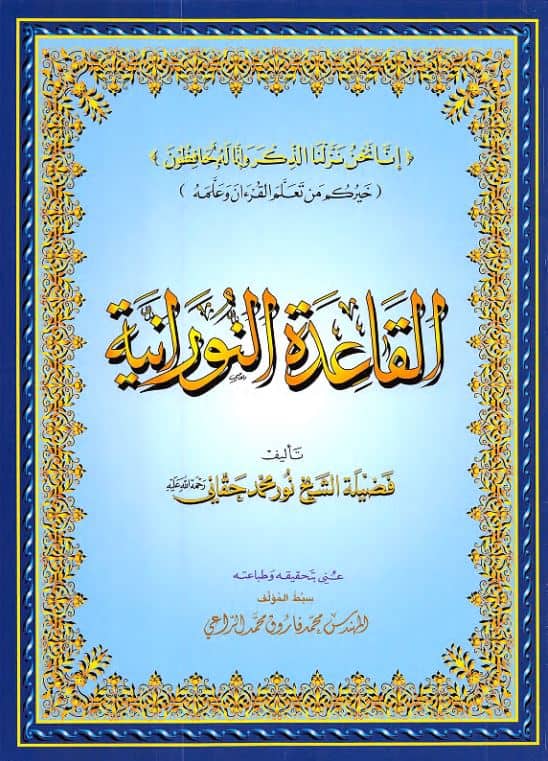
Download the Complete Noorani Qaida PDF (Free)
Don’t let the learning stop here. Get the exact book used by our Sheikhs. High-quality, clear script, and perfect for offline practice on any device.
- ✅ Crystal Clear Arabic Script
- ✅ Compatible with Mobile & Tablet
- ✅ 100% Free for Students
File size: Lightweight & Fast (PDF)
🎓 For Teachers: Teaching Methodology
1. Spelling vs. Reading (Hijjaa vs. Rawan)
2. The Circle of Sifr Mustadir (o)
Master the Art of Quran Recitation
Don’t rely on self-study alone. Get your pronunciation checked by a certified Al-Azhar Sheikh today.
- ✨ 1-on-1 Live Private Session
- ✨ Native Arab Tutors (Male & Female)
- ✨ 100% Free Evaluation – No Commitment
🔒 No Credit Card Required
💬 Common Questions About Lesson 6
Clear answers to help you master the exercises.
Why is there a circle on the Alif in “Ana” (أَنَا)?
This symbol indicates a “Silent Letter” (Sifr Mustadir). In this specific word throughout the Quran, you should pronounce the Noon quickly and ignore the Alif completely. Read it as “Ana”, NOT “Anaaa”.
Should I read by spelling (Hijjaa) or directly (Rawan)?
Beginners: Start with spelling (e.g., “Hamza Fatha A, Ba Fatha Ba -> Aba”) to understand the structure.
Advanced: Once comfortable, practice reading directly (e.g., “Aba”) to build fluency and speed.
What does the small ‘Yaa’ in (طُوًی) mean?
This represents Alif Maqsura. In this specific case with Tanween (Fathatain), it acts as a “seat” or “chair” for the Tanween, just like a regular Alif. Pronounce the word as “Tuwan”.
Why is the word (أَحَدٌ) pronounced “Ahadun”?
Because it ends with Dammatain (Double Damma). The symbol ( ٌ ) adds an “Un” sound to the letter Dal.
Formula: Dal + Damma + Noon = Dun.
How do I stop on a word like (أَحَدٌ)?
Stopping Rule (Waqf): If you stop breathing at this word, you change the Tanween to a Sukoon. You read it as “Ahad”.
Continuing: If you connect it to the next word, you read “Ahadun…”.
Are these words from the Quran?
Yes! All examples in Lesson 6 are actual words found in the Holy Quran (like Surah Al-Ikhlas, Surah Taha, etc.). Practicing them here prepares you for real recitation.
You Are Reading Words Now! 🌟
Completing Lesson 6 is a massive milestone. You have moved from letters to full words. You are officially reading Arabic!
Want to see the full roadmap?
Access the complete Noorani Qaida Syllabus (All 17 Lessons)
🎓 Ready to Level Up?
Don’t just read alone. Join our live classes with expert Sheikhs.


