
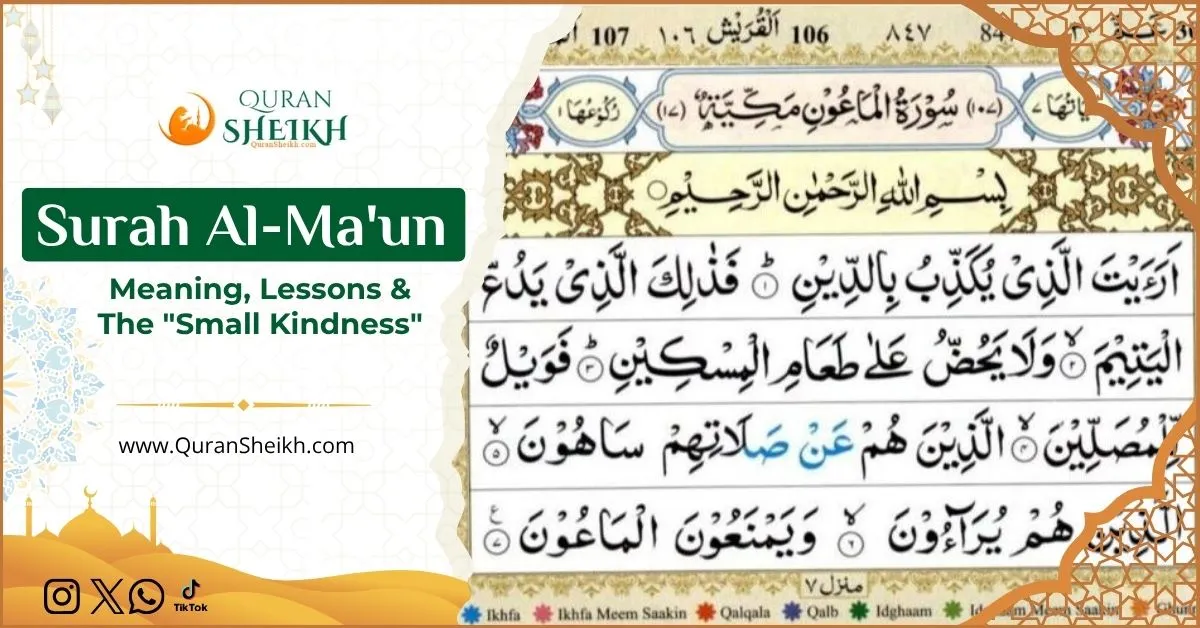
Discover the powerful lessons of Surah Al-Ma’un. Understand the warning against empty prayers, hypocrisy, and the true meaning of “Small Kindnesses.”
Introduction: Have You Seen the One?
This Surah begins with one of the most piercing questions in the entire Quran: “Have you seen the one who denies the Recompense?” (107:1).
What does this person look like? We might expect a description of an outspoken atheist or a tyrant. But Allah gives us a different, more chilling answer.
This short, 7-verse (Meccan) Surah, Surat Al-Ma’un (Small Kindnesses), is a profound social commentary. It draws an unbreakable line between what we believe in our hearts (faith in the Day of Judgment) and how we act in our daily lives (how we treat the vulnerable).
It serves as a terrifying mirror, forcing us to ask: Is our Salah (prayer) a true act of worship, or is it an empty ritual disconnected from the core teachings of Islam?
Listen to Surah Maun: Recitation by Sheikh Mishary Rashid Alafasy
Listen to this beautiful recitation to perfect your pronunciation and reflect on the meanings before reading the explanation.
The Anatomy of Denial: Understanding the 7 Verses
This Surah is split into two distinct parts: the description of the one who denies the faith in practice, and the warning to those who pray without sincerity.
Verses 1-3: The Proof of a Hardened Heart
1. Ara-aital lazee yu kazzibu bid deen (Have you seen the one who denies the Recompense?) 2. Fa zaalikal lazi yadu’ul-yateem (For that is the one who drives away the orphan,) 3. Wa la ya huddu ‘alaa ta’amil miskeen (And does not encourage the feeding of the poor.)
- The Contemplation: Allah provides the immediate evidence of this denial. The proof that someone doesn’t truly believe in a Day of Judgment is not in their words, but in their actions.
- They “drive away the orphan”—not just ignoring them, but treating them with harshness, fully aware of their power over someone weak.
- They don’t just “not feed” the poor—they don’t even encourage others to do so. Their heart is so hard that the plight of the hungry does not move them in the slightest. This social apathy is a direct symptom of a dead faith.
Verses 4-7: The Terrifying Warning to the ‘Worshippers’
This is where the Surah pivots and becomes truly terrifying. It moves from the obvious disbeliever to the one who claims to be a believer:
4. Fa wai lul-lil mu salleen (So woe to those who pray,) 5. Al lazeena hum ‘an salaatihim sahoon ([But] who are heedless of their prayer,) 6. Al lazeena hum yuraa-oon (Those who make show [of their deeds],) 7. Wa yamna’oonal ma’oon (And withhold [simple] assistance.)
- The Contemplation: This is a “Woe” (Wayl) — a declaration of destruction — aimed at “Musalleen” (those who pray). How can this be?
- They are “Heedless” (Sahoon): They pray, but their heart isn’t in it. They delay their prayers past their times, rush through them, or perform them as a “checklist” item without any remembrance of Allah.
- They “Make Show” (Yuraa’oon): They perform their good deeds and prayers only to be seen by others. Their goal is the praise of people, not the pleasure of Allah. This is Riya (showing off), a form of hypocrisy that destroys the value of all deeds.
- They “Withhold Al-Ma’un” (The Small Kindnesses): This is the final proof. They are so disconnected from the spirit of Islam that they refuse to even give Al-Ma’un—the “small kindnesses.”
What is ‘Al-Ma’un’? The Smallest Test of Faith
The entire Surah is named after this final, powerful word: Al-Ma’un. So what is it?
Abdullah ibn Masud (ra), a great companion, said: “During the time of the Messenger of Allah (ﷺ) we used to consider ma’un (things of daily use) lending a bucket and cooking-pot.“
This is the key. Al-Ma’un is not about massive, bank-breaking charity. It’s about the small, everyday acts of kindness. It’s lending your neighbor a tool, giving someone a glass of water, or even, as the Tafseer mentions, “something as simple as a smile.”
The Surah teaches us that the person whose prayer is empty is the same person who is too selfish to even perform these small, simple acts of neighborly kindness.
The Smart Bridge: The Cure for ‘Heedless’ Prayer
The core problem identified in this Surah is not the act of prayer itself, but the heedlessness (‘an salaatihim sahoon) within it.
How do we cure a heedless prayer? By moving from “showing” to “knowing.” We cure it with Khushu (presence and humility). And how do we achieve Khushu? By understanding what we are saying.
When you stand for prayer and you understand the words of Surah Al-Fatihah, when you feel the meaning of “Allahu Akbar,” your prayer transforms from a “heedless” ritual into a “heartfelt” connection. This connection is what softens the heart and makes it impossible to turn away an orphan or withhold Al-Ma’un.
This is why learning the Quran’s language and Tafseer (explanation) is not an academic luxury; it is the essential cure for the very disease Surah Al-Ma’un warns against. At Quran Sheikh online Quran learning, our one-on-one tutors are dedicated to helping you build this profound connection, turning your prayer from a “heedless” act into a life-changing dialogue.
Your Daily Mirror: Are You a Worshipper or Just a ‘Performer’?
Surah Al-Ma’un is our daily mirror. It forces us to ask: Is our Islam complete?
A true believer has two wings: Haqq Allah (The Rights of Allah, like Salah) and Haqq al-‘Ibad (The Rights of the People, like Al-Ma’un).
One wing is useless without the other. This Surah is the eternal reminder that our prayer is only as valuable as our kindness.

For Reference: Transliteration and Translation
Ara-aital lazee yu kazzibu bid deen (Have you seen the one who denies the Recompense?)
Fa zaalikal lazi yadu’ul-yateem (For that is the one who drives away the orphan.)
Wa la ya huddu ‘alaa ta’amil miskeen (And does not encourage the feeding of the poor.)
Fa wai lul-lil mu salleen (So woe to those who pray,)
Al lazeena hum ‘an salaatihim sahoon ([But] who are heedless of their prayer,)
Al lazeena hum yuraa-oon (Those who make show [of their deeds],)
Wa yamna’oonal ma’oon (And withhold [simple] assistance.)
Frequently Asked Questions About Surah Al-Ma’un
What is the main theme of Surah Al-Ma’un?
The main theme is the inseparable link between faith and social responsibility. It warns against those who perform rituals (like prayer) but neglect the rights of the vulnerable (orphans and the poor) and refuse small acts of kindness.
What does “Al-Ma’un” mean?
"Al-Ma'un" translates to "Small Kindnesses," "Daily Necessities," or "Assistance." It refers to small, everyday items or acts of help (like lending a tool, giving water, or salt) that neighbors typically share.
Who are the “Sahoon” (heedless) mentioned in the Surah?
"Sahoon" refers to those who are neglectful of their prayers. This includes people who delay prayer beyond its time without excuse, or those who pray physically but without any spiritual focus or remembrance of Allah.
What is “Riya” (showing off) in Islam?
Riya is performing acts of worship (like prayer or charity) solely to be seen and praised by people, rather than seeking the pleasure of Allah. Surah Al-Ma'un condemns this as a sign of hypocrisy.
Is Surah Al-Ma’un Meccan or Medinan?
There is a difference of opinion, but the majority of scholars classify it as a Meccan Surah. Some scholars suggest the first half is Meccan and the second half (about prayer) is Medinan.
Why does the Surah link denying the Recompense with mistreating orphans?
To show that true belief in the Day of Judgment must manifest in compassionate behavior. A person who harshly drives away an orphan shows a hardness of heart that contradicts true faith in divine accountability.
How many verses are in Surah Al-Ma’un?
Surah Al-Ma'un consists of 7 verses (ayat).
What is the “Ara-aital lazee…” mentioned in verse 1?
It translates to "Have you seen the one who denies the Recompense?" It is a rhetorical question designed to draw attention to the characteristics of such a person (mistreating orphans, neglecting prayer).
What is the lesson regarding “encouraging feeding the poor”?
The lesson is that it is not enough to just feed the poor oneself; a believer must also be an advocate for the poor, encouraging others in society to help and feed the needy.
Can a person pray and still be in danger according to this Surah?
Yes. Verse 4 says "Woe to those who pray" if their prayer is characterized by heedlessness (Sahoon) and showing off (Riya), and if it does not lead them to be kind to others (Ma'un).