Introduction: The Short Surah with the Weight of a Third
For nearly every Muslim, Surah Al-Ikhlas (Sincerity) is one of the very first chapters we learn as children. Its four short, powerful verses are easy to memorize and are a constant presence in our daily prayers.
But because of its simplicity, we sometimes forget its sheer spiritual weight. This Surah is not just another short chapter; it is the absolute foundation of our faith.
The Prophet Muhammad (ﷺ) posed a question to his companions: “Is it difficult for one of you to recite a third of the Quran in a single night?” They found this difficult, so he (ﷺ) revealed the answer: “Allah, the One, the Master (Surah Al-Ikhlas) is worth one-third of the Quran.” (Sahih Bukhari)
How can four short verses equal one-third of the entire revelation? This article is a journey to understand the profound power packed into this Surah — a power that defines our faith, guarantees our salvation, and opens the doors to Paradise.
Listen to Surah Al-Ikhlas: Recitation by Sheikh Mishary Rashid Alafasy
Listen to this beautiful recitation to perfect your pronunciation and reflect on the meanings before reading the explanation.
The Divine Answer: Understanding the 4 Verses of Tawhid
This Surah (a Meccan surah) was revealed at a time when polytheists in Mecca challenged the Prophet (ﷺ), asking, “O Muhammad! Tell us the lineage of your Lord. Who is He? What is He made of?”
In response, Allah did not send a long, philosophical argument. He sent a short, decisive, and eternal declaration — the very definition of His existence, known as Surat al-Tawhid (The Chapter of Monotheism).
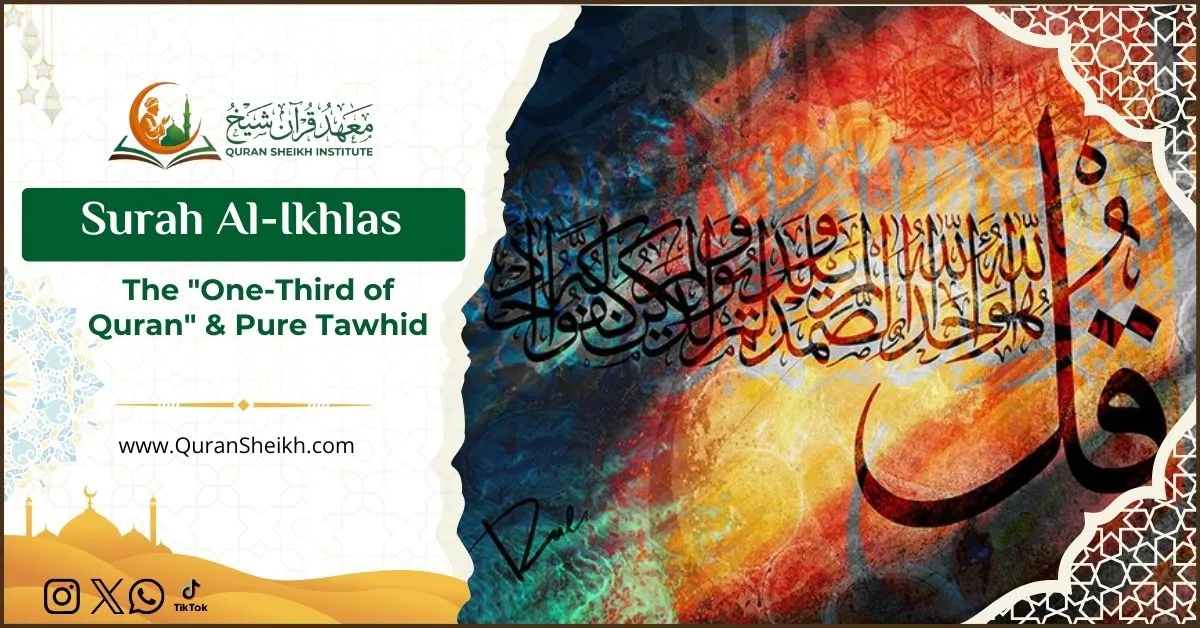
1. Qul huwal laahu ahad (Say, “He is Allah, [who is] One,”)
- The Contemplation: This is the core. It starts with “Say” (Qul), making it a direct command for us to declare. He is Ahad (One). This word is unique. It doesn’t just mean “one” in number (like wahid); it means “The One and Only,” “The Unique,” “The Indivisible.” It negates any idea of partners, associates, or components.
2. Allah hus-samad (Allah, the Eternal Refuge.)
- The Contemplation: He is As-Samad. This is one of the most comprehensive Names of Allah. It means He is the Eternal, the Absolute, the Self-Sufficient Master. All of creation depends on Him for everything, while He depends on no one. He is the one we turn to for all our needs — He neither eats nor drinks nor has any needs Himself.
3. Lam yalid wa lam yoolad (He neither begets nor is born,)
- The Contemplation: This verse directly refutes the pagan and polytheistic claims that the Prophet (ﷺ) was asked about. It negates the idea of lineage, parents, or children. He is not “born” (He has no beginning) and He does not “beget” (He has no son or daughter). His existence is absolute and uncreated.
4. Wa lam yakul-lahu kufuwan ahad (Nor is there to Him any equivalent.”)
- The Contemplation: This is the final, definitive statement. Nothing is comparable to Him. Not in His attributes, not in His power, and not in His essence. He is utterly unique. This verse concludes the declaration, leaving no room for any form of comparison or polytheism.
The ‘One-Third’ Secret: Why This Surah is So Immensely Valuable
How can these four verses equal one-third of the Quran? The scholars explain it beautifully. The entire Quran, in essence, revolves around three core themes:
- Tawhid (Creed): The knowledge of Allah, His names, and His attributes.
- Ahkam (Rulings): The laws, commands, and prohibitions (what to do, what not to do).
- Qisas (Stories): The stories of the Prophets, past nations, and the unseen (Jannah, Jahannam).
Surah Al-Ikhlas is the complete and perfect summary of the first theme: Tawhid. It is the Asas (The Foundation) of our faith. Because it so purely defines who Allah is, reciting it with understanding and belief is like reciting the entire “Tawhid” portion of the Quran.
A Love That Guarantees Paradise
The power of this Surah goes beyond its theological weight; it is a direct key to Jannah. But this key is not just in its recitation — it’s in the love for it.
A companion of the Prophet (ﷺ) used to lead the prayers and would conclude his recitation in every single rak’ah with Surah Al-Ikhlas. The people complained to the Prophet (ﷺ). The Prophet (ﷺ) asked him, “Why do you do this?” The man replied, “Because I have great love for it.”
The Prophet Muhammad (ﷺ) gave him the ultimate reward: “Your love for this surah has earned you entry to Paradise.” (Sahih Bukhari)
This story teaches us that our love for the declaration of Allah’s Oneness is a direct measure of our faith. This love is what makes it An-Najah (The Salvation) and Al-Barā’ah (The Freedom from polytheism).
The Smart Bridge: From Love to Perfected Recitation
That companion’s love for the Surah was so great that he recited it constantly, making it the foundation of his prayer. This is the goal: to move from just knowing the Surah to loving it.
And how do we express love for the Quran? By reciting it as beautifully as it was revealed. By perfecting its pronunciation (Tajweed), we honor the very words that define our Lord. The clearer our recitation, the deeper our connection and love.
This journey from simple recitation to a profound expression of love is what we are passionate about. If you wish to deepen your love for the Quran by perfecting its recitation, the expert tutors at Quran Sheikh online Quran learning are here to guide you, one-on-one, to recite with the beauty and clarity this Surah deserves.
Your Daily Declaration of Faith
Surah Al-Ikhlas is more than a short chapter. It is Al-Mudhakkirah (The Reminder) and An-Nūr (The Light).
It is your daily declaration of faith, your shield from polytheism, and your proof of love for Allah. The Prophet (ﷺ) said, “Whoever recites [Surah Al-Ikhlas] ten times, Allah will build a palace for him in Paradise.” (Musnad Ahmad)
Let every recitation be a renewal of your Tawhid, a foundation for your faith, and another stone in your palace in Jannah.

For Reference: Transliteration and Translation
Qul huwal laahu ahad (Say, “He is Allah, [who is] One,)
Allah hus-samad (Allah, the Eternal Refuge.)
Lam yalid wa lam yoolad (He neither begets nor is born,)
Wa lam yakul-lahu kufuwan ahad (Nor is there to Him any equivalent.”)
Frequently Asked Questions About Surah Al-Ikhlas
[rank_math_rich_snippet id=”s-6730c316-6e25-4ec2-bed9-3d0847698268″]