Introduction: “Have You Not Considered?”
The Surah begins with one of the most direct and powerful questions in the Quran: “Have you not considered, [O Muhammad], how your Lord dealt with the companions of the elephant?” (105:1).
This wasn’t a question about a long-lost legend. This (Meccan) Surah was revealed to a people who knew this story intimately. The “Year of the Elephant,” the year the Prophet (ﷺ) himself was born, was a defining moment in their history. It was the year the impossible happened.
This Surah is not just a history lesson. It is a profound and eternal reminder that no plan, no power, and no “elephant” (no matter how large) can stand against the will and protection of Allah.
Listen to Surah Al-Fil: Recitation by Sheikh Mishary Rashid Alafasy
Listen to this beautiful recitation to perfect your pronunciation and reflect on the meanings before reading the explanation.
The Anatomy of a Divine Miracle: Understanding the 5 Verses
This Surah is a short, dramatic narrative of an overwhelming threat and a miraculous deliverance.
1. Alam tara kaifa fa’ala rabbuka bi ashaabil feel (Have you not considered how your Lord dealt with the companions of the elephant?)
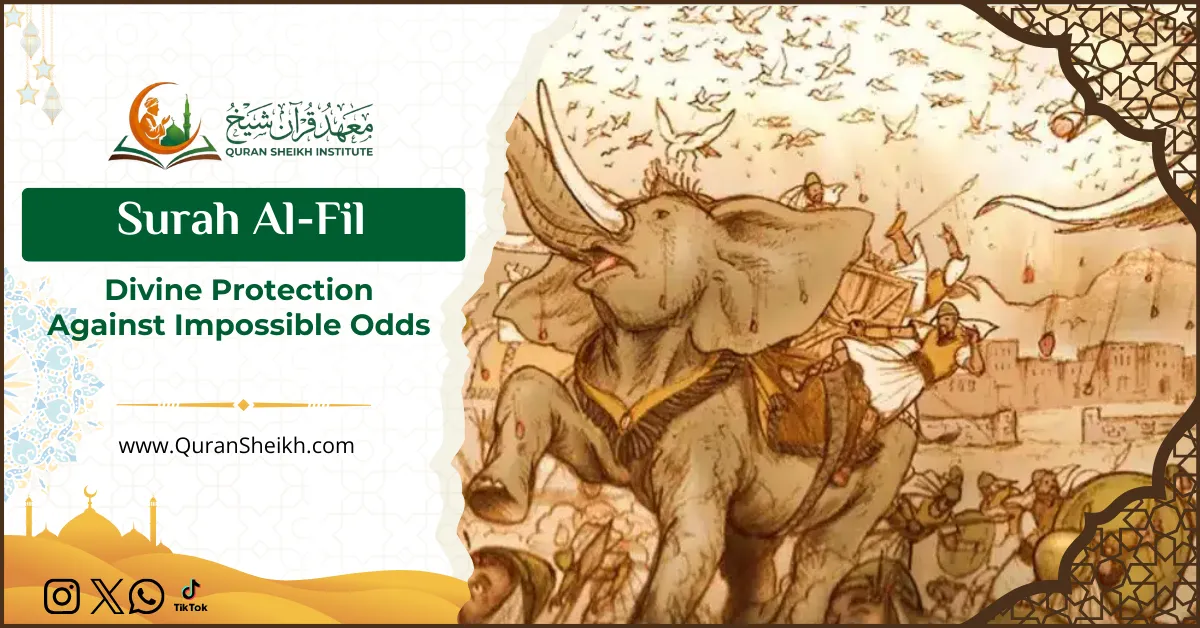
- The Contemplation (The Reflection): Allah asks the Prophet (ﷺ) and all of us to reflect. “Don’t you see the proof?” The event was famous. Abrahah, a powerful viceroy from Yemen, marched on Makkah with a massive army, including war elephants, with one goal: to destroy the Ka’bah. The people of Makkah, including the Quraish, were defenseless and fled to the mountains.
2. Alam yaj’al kai dahum fee tad leel (Did He not make their plan into misguidance?)
- The Contemplation (The Failure): “Tadleel” means total loss, confusion, and misguidance. Their meticulous, powerful, and terrifying plan was rendered completely useless. Allah didn’t just stop their plan; He made it fail spectacularly.
3. Wa arsala ‘alaihim tairan abaabeel (And He sent against them birds in flocks,) 4. Tar meehim bi hi jaaratim min sij jeel (Striking them with stones of hard clay,)
- The Contemplation (The Army of Allah): Here is the miracle. Allah did not send an opposing army or a natural disaster. He sent Tairan Abaabeel (birds in flocks)—one of the weakest of creatures. These birds carried Sijjeel (small stones of hard-baked clay). The most powerful army on earth was brought down by the weakest creatures carrying the most insignificant weapons.
5. Faja ‘alahum ka’asfim m’akool (And He made them like eaten straw.)
- The Contemplation (The Result): This is the vivid, devastating conclusion. “Ka’asfim Ma’kool” means “like chewed-up straw” or “husks of corn eaten by cattle.” They were not just killed; they were disintegrated and left worthless. It is a powerful image of complete and utter annihilation, showing the true powerlessness of creation against the Creator.
The Inseparable Link: Why Surah Al-Fil is the Preface to Surah Quraish
This Surah is not a standalone story. It is the direct preface and cause for the Surah that follows it, Surah Quraish.
- Surah Al-Fil (The Cause): Allah demonstrates His power by miraculously protecting the Ka’bah from Abrahah’s army.
- Surah Quraish (The Effect): Because of this event, the sanctity and security of the Ka’bah were established across all of Arabia. This divine protection is what gave the Quraish tribe their “Ilaf” (a pact of safety) to travel for their “winter and summer caravans,” making them wealthy and safe in a land of war.
You cannot fully understand the blessings in Surah Quraish (“feeding them from hunger and making them safe from fear”) without first understanding the miracle in Surah Al-Fil that made those blessings possible.
The Smart Bridge: The Power of Context in Understanding the Quran
This link between the two Surahs is a perfect example of why just reading a translation is not enough. Without understanding the Tafseer (explanation) and the historical context (Sabab an-Nuzul), the profound economic and spiritual lesson is lost.
The Quran is a deep, interconnected message. To truly feel its power, you must understand how and why the verses were revealed.
At Quran Sheikh online Quran learning, our expert, one-on-one tutors specialize in this. We guide you beyond the surface to understand the deep, interconnected wisdom of the Quran, turning your recitation from a habit into a profound journey of discovery.
Your Personal Lesson: No “Elephant” is Too Big for Allah
Surah Al-Fil is our eternal reminder of where true power lies. In our own lives, we all face “elephants”—problems that seem too big, enemies that seem too strong, or obstacles that feel impossible.
This Surah asks us: “Have you not considered…?” It commands us to remember that the Lord who protected His House from an army of elephants with a flock of birds is the same Lord we turn to today.
No matter how big your problem is, Allah’s plan is greater.

For Reference: Transliteration and Translation
Alam tara kaifa fa’ala rabbuka bi ashaabil feel (Have you not considered, [O Muhammad], how your Lord dealt with the companions of the elephant?)
Alam yaj’al kai dahum fee tad leel (Did He not make their plan into misguidance?)
Wa arsala ‘alaihim tairan abaabeel (And He sent against them birds in flocks,)
Tar meehim bi hi jaaratim min sij jeel (Striking them with stones of hard clay,)
Faja ‘alahum ka’asfim m’akool (And He made them like eaten straw.)
Frequently Asked Questions About Surah Al-Fil
[rank_math_rich_snippet id=”s-cb386a95-a1b8-4ee7-9c48-639cee5a7b77″]