
The Ultimate Combo: Power & Brakes 🛑💪
Welcome to Lesson 14. You have mastered the “Stop” (Sukoon) and the “Press” (Shaddah). Now, the Quran challenges you to combine them.
In this lesson, you will encounter words that have a Shaddah followed immediately by a Sukoon. This is a test of your tongue’s agility: can you press a letter hard and then stop instantly on the next one?
Let’s master this complex rhythm! 👇
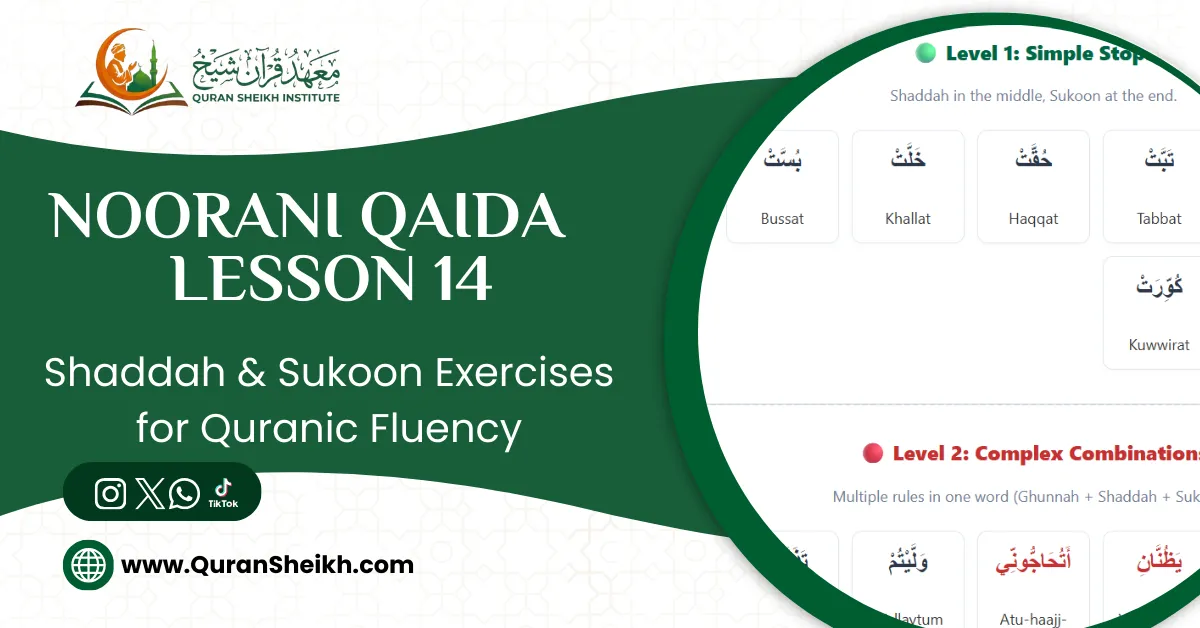
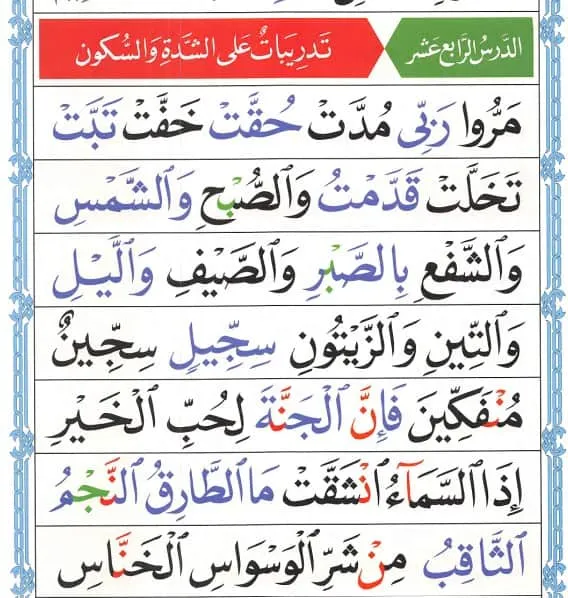
Marrat
Khaffat
Tabbat
Haqqat
Khallat
Bussat
Huddat
Sujjirat
Fujjirat
Kuwwirat
🔴 Level 2: Complex Combinations
Multiple rules in one word (Ghunnah + Shaddah + Sukoon).
‘Allam-na
Asrartu
Yazun-naani
Atu-haajj-oonni
Wallaytum
Tazakkarta
Ta’allamtum
Yash-shaqqaqu
📺 Watch the Full Lesson: Listen & Repeat

🧬 The Anatomy of “Shaddah + Sukoon”
How to flow from a Mountain (Shaddah) to a Wall (Sukoon).
Example: ( مَرَّتْ ) – Marr-rat.
Use the “Marr” to launch into the “Rat”, then stop sharply on the “T”.
💡 Golden Tips for Lesson 14
1. Don’t Drop the Shaddah
When you see a Sukoon after Shaddah (like Tabbat), don’t rush so much that the Shaddah disappears. The “Ba” must still feel heavy and doubled.
2. The “Hams” of Ta ( تْ )
Many words in this lesson end with “Ta” Sukoon (تْ). Remember to release a tiny “whisper” of air at the very end. (Marrat-h).
3. Heavy vs Light
In words like ( حُقَّتْ ), transition smoothly from the heavy “Qaf” to the light “Ta”. Don’t make the “Ta” heavy just because the “Qaf” is heavy.
📥 Take the Classroom Home
Download the Complete Noorani Qaida PDF (Free)
Don’t let the learning stop here. Get the exact book used by our Sheikhs. High-quality, clear script, and perfect for offline practice on any device.
- ✅ Crystal Clear Arabic Script
- ✅ Compatible with Mobile & Tablet
- ✅ 100% Free for Students
File size: Lightweight & Fast (PDF)
🎓 For Teachers: Diagnostic Checks
1. The “Nab’r” (Accent) Rule
2. Timing of Consonant Clusters
Master the Art of Quran Recitation
Don’t rely on self-study alone. Get your pronunciation checked by a certified Al-Azhar Sheikh today.
- ✨ 1-on-1 Live Private Session
- ✨ Native Arab Tutors (Male & Female)
- ✨ 100% Free Evaluation – No Commitment
🔒 No Credit Card Required
💬 Common Questions About Lesson 14
Mastering the Shaddah-Sukoon combination.
Why is this lesson difficult?
Because you are dealing with 3 letter sounds packed into a small space: The first part of Shaddah (Silent), the second part (Moving), and then the final Sukoon (Silent).
How do I stop on a word ending in Shaddah?
If you stop on a word like (تَبّ), you still pronounce the Shaddah by holding the letter tight (Nab’r) before cutting the sound. Don’t just make it a light Sukoon.
Do I Qalqalah the “Ta” in (مَرَّتْ)?
No! “Ta” is NOT a Qalqalah letter. Never bounce it. Instead, use Hams (a gentle release of air/whisper) at the end.
What about (حُقَّتْ)? Is Qaf a Qalqalah?
The Qaf here has a Shaddah (Haq-qat). You do NOT bounce the first Qaf (because it merges into the second). You only bounce Qaf if it has a standalone Sukoon.
How to handle the breathing?
Words with Shaddah take more breath. Inhale before the word, and exhale forcefully on the Shaddah to give it strength.
Is the Noon in (عَلَّمْنَ) nasal?
No. The Noon here has a Fatha (Na), not a Shaddah. So it is short (1 count) and not buzzed (No Ghunnah). Only Noon Mushaddadah (نّ) has Ghunnah.
Can I use Hijja (Spelling) for this lesson?
Yes, Hijja is very helpful here to break down the cluster. Example: “Meem Fatha Ra Shaddah -> Marr”, “Ra Fatha Ta Sukoon -> Rat” = “Marrat”.
You’ve Conquered the Combo!
Combining Shaddah and Sukoon is one of the hardest skills for beginners. If you can read (مَرَّتْ) clearly, you are ready for the advanced rules of the Quran.
Want to see the full roadmap?
Access the complete Noorani Qaida Syllabus
🎓 Ready to Level Up?
Don’t just read alone. Join our live classes with expert Sheikhs.


