
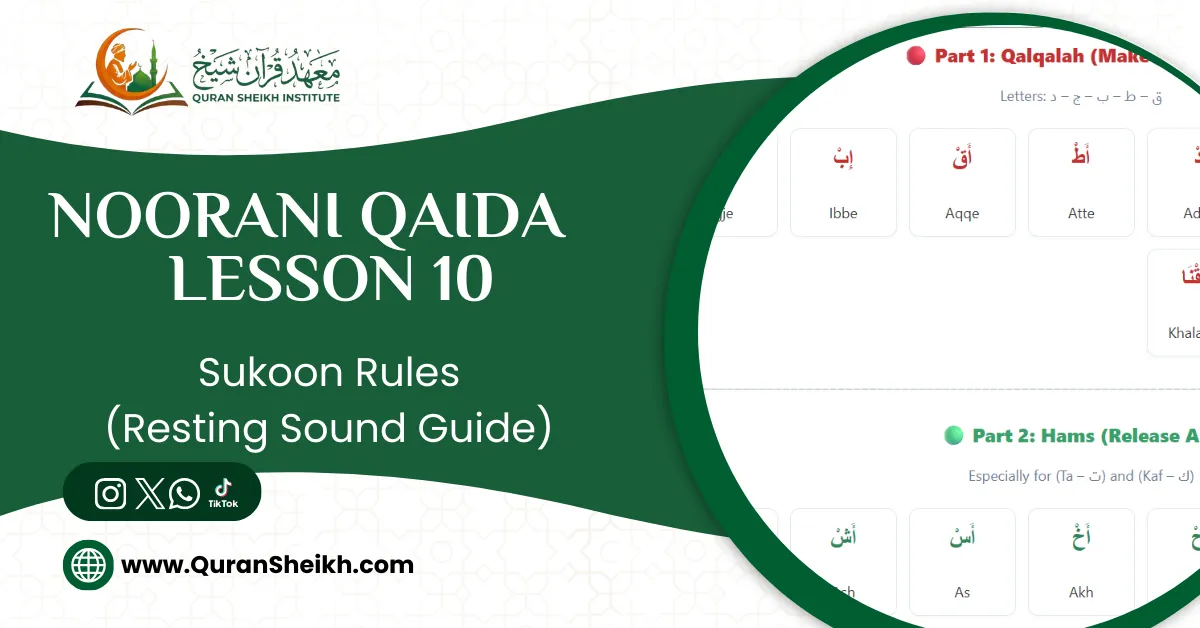
The Magic of “The Pause” 🛑✨
Welcome to Lesson 10. You have learned how to move sounds (Fatha, Kasra, Damma). Now, it’s time to learn how to STOP them.
Sukoon ( ـْ ) is the braking system of the Quran. But be careful! Some letters bounce when you stop (Qalqalah), and some release air (Hams). It’s not just silence; it’s an art.
Ready to control the rhythm? Let’s jump in! 👇
Abbe
Ajje
Adde
Atte
Aqqe
Ibbe
Ijje
Ubbe
Yad-khuluna
Khalaq-na
🟢 Part 2: Hams (Release Air)
Especially for (Ta – ت) and (Kaf – ك)
At-h
Ath
Ah
Akh
As
Ash
As
Ak-h
Fit-natun
Tak-sibuna
📺 Watch the Full Lesson: Listen & Repeat

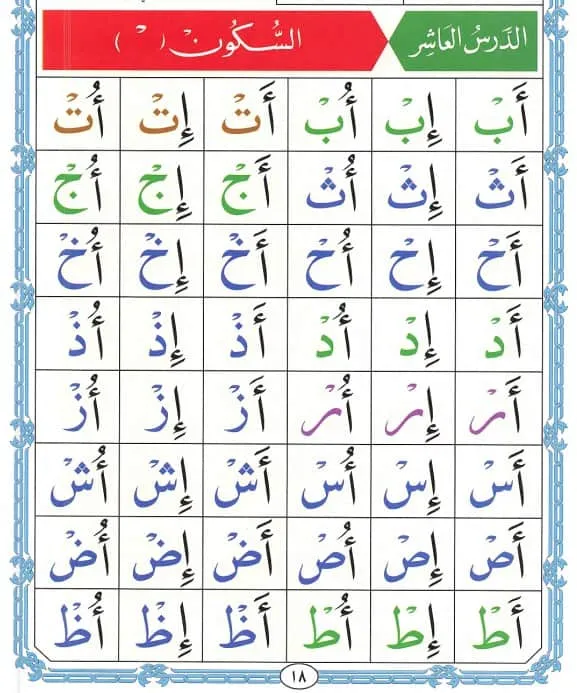
🧬 The Physics of Stopping
Not all stops are the same. Watch the difference!
1. Qalqalah (The Bounce)
When you stop on these 5 letters, the sound must bounce back (echo). Don’t cut it off!
Mnemonic: “Qutb Jad”
Example: أَبْ (Ab-be)
2. Hams (The Whisper)
When you stop on these letters, let a stream of air flow out gently.
Release the air!
Example: أَتْ (At-h)
💡 Golden Tips for Lesson 10
1. The “Echo” Test
Place your hand on your throat. When saying Qalqalah letters (Ab, Aq), you should feel a distinct vibration or “click” at the end. If it’s flat, try releasing the sound faster.
2. The “Snake” Sound 🐍
For letters like Seen (س) and Sad (ص), the Sukoon makes a hissing sound. Hold it for a split second: “Assss”. Don’t bounce it!
3. Heavy vs. Light
Watch out for Raa (ر) with Sukoon. If it has Fatha/Damma before it -> Heavy (Arr). If Kasra before it -> Light (Irr).
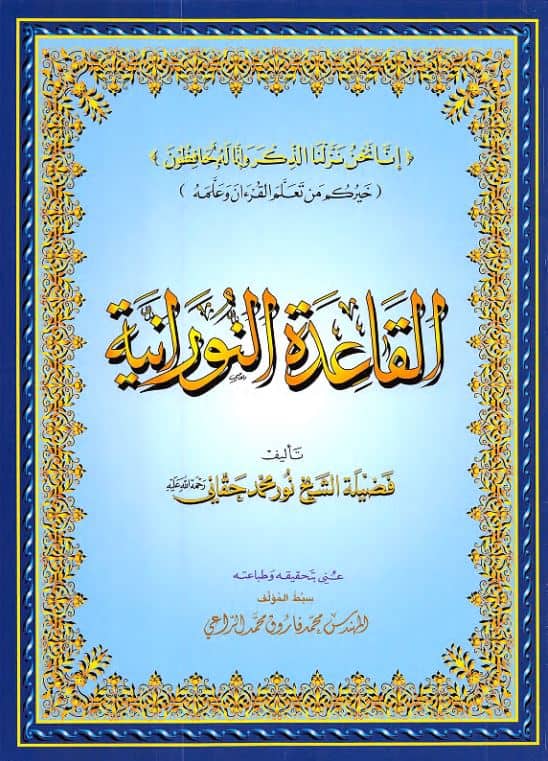
📥 Take the Classroom Home
Download the Complete Noorani Qaida PDF (Free)
Don’t let the learning stop here. Get the exact book used by our Sheikhs. High-quality, clear script, and perfect for offline practice on any device.
- ✅ Crystal Clear Arabic Script
- ✅ Compatible with Mobile & Tablet
- ✅ 100% Free for Students
File size: Lightweight & Fast (PDF)
🎓 For Teachers: Advanced Insights
1. Levels of Qalqalah
2. The “Hams” in Ta and Kaf
Master the Art of Quran Recitation
Don’t rely on self-study alone. Get your pronunciation checked by a certified Al-Azhar Sheikh today.
- ✨ 1-on-1 Live Private Session
- ✨ Native Arab Tutors (Male & Female)
- ✨ 100% Free Evaluation – No Commitment
🔒 No Credit Card Required
💬 Common Questions About Lesson 10
Expert answers to master Sukoon and Qalqalah.
What is the meaning of “Sukoon”?
Sukoon (ـْ) means “Resting” or “Stillness”. It indicates that the letter has no vowel (no Fatha, Kasra, or Damma). You simply pronounce the sound of the letter and stop. Example: أَبْ (Ab).
Which letters must “Bounce” (Qalqalah)?
Only 5 letters bounce when they have Sukoon: Qaf (ق), Ta (ط), Ba (ب), Jeem (ج), Dal (د). Remember the phrase “Qutb Jad”. Example: أَقْ (Aqq-e).
How do I pronounce ‘Ta’ (ت) with Sukoon?
Do NOT bounce it! Instead, release a small puff of air (whisper/Hams) at the end. It sounds like “At-h”, not “At-te”.
Why does ‘Raa’ (ر) sound heavy sometimes?
If the letter before the Raa has Fatha or Damma, pronounce Raa heavily (Arr/Urr). If the letter before has Kasra, pronounce it lightly (Irr).
Can a word start with a Sukoon?
No, never. In Arabic, you cannot begin speech with a resting letter. There must always be a moving letter (Harakah) before a Sukoon to “launch” the sound.
How do I stop on ‘Kaf’ (ك)?
Like ‘Ta’, ‘Kaf’ is a whispering letter (Hams). When stopping (Ak), release a tiny “k-h” sound. Do not bounce it like Qalqalah.
What if I bounce a non-Qalqalah letter?
This is a common mistake called “Adding a Vowel”. For example, saying “An-na” instead of “An”. Practice holding the sound firmly (like stopping a car) without letting it rebound.
You’ve Mastered the Art of Stopping! 🛑
Congratulations! You now possess the “Brakes” of Quranic recitation. You know when to Bounce (Qalqalah) and when to Whisper (Hams). Without this lesson, recitation would be a continuous stream without rhythm.
🎓 Ready to Level Up?
Don’t just read alone. Join our live classes with expert Sheikhs.


