
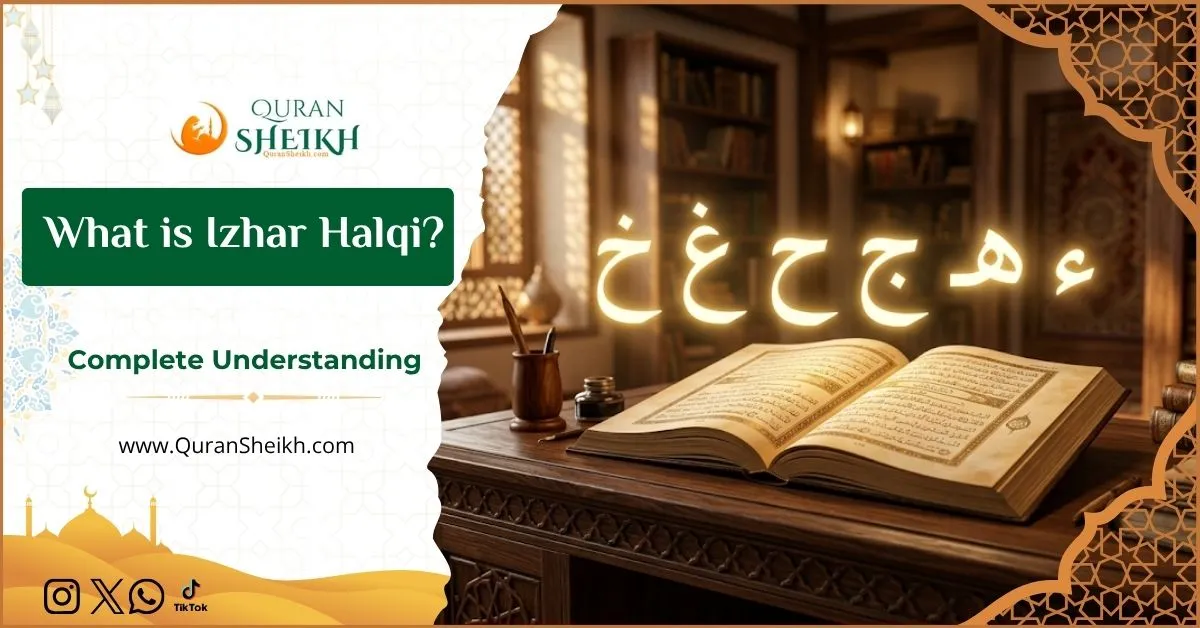
Izhar Halqi is one of the basic Tajweed rules that helps Muslims recite the Quran clearly and correctly. The word “Izhar” means clarity, while “Halqi” relates to the throat. In Quran recitation, Izhar Halqi happens when Noon Sakinah or Tanween comes before one of the six throat letters, causing the sound to be pronounced clearly without merging or hiding.
Learning Izhar Halqi is important for proper Quran memorization and beautiful recitation. It protects the meaning and pronunciation of Quranic words while improving fluency in Hifz. Many beginners study this rule early because it appears frequently throughout the Quran and builds a strong Tajweed foundation.
💡 Key Takeaways: What Is Izhar Halqi? Complete Understanding
- The Rule Breaks Down Into Exactly 18 Distinct Forms: Combining Noon Sakinah plus the Fathatan and Kasratan tanween types with each of the 6 throat letters produces 18 separate documented combinations of this one rule.
- Izhar Halqi’s Clarity Comes in Three Different Strength Levels: ء and هـ from the deepest throat produce the strongest clarity, ع and ح from the middle throat are moderate, and غ and خ from the upper throat are slightly lighter.
- The Rule Name Itself Encodes Both Its Function and Location: ‘Izhar’ means clarity while ‘Halqi’ derives from ‘Halaq’ (throat), so the term literally describes both what happens and where the trigger letters originate.
- Distance Between Articulation Points Is Given as the Reason Merging Never Happens: Because Noon’s tongue-based origin sits so far from the throat, the two sounds naturally can’t blend, so Izhar Halqi needs nothing beyond normal pronunciation.
What Is Izhar Halqi?
Izhar Halqi is a Tajweed rule in which Noon Sakinah (نْ) or Tanween is pronounced clearly when followed by one of the six throat letters. The word “Izhar” means clarity, while “Halqi” relates to the throat. In this rule, the sound is recited openly without merging, hiding, or changing the pronunciation.
Izhar Halqi is one of the four main rules of Noon Sakinah and Tanween in Tajweed. Muslims apply it during Quran recitation to preserve the correct sound and meaning of Quranic words.
Meaning of Izhar and Halqi in Tajweed
In Tajweed, the word “Izhar” means to pronounce something clearly and distinctly. It requires the reader to recite the Noon Sakinah or Tanween without nasal merging or concealment.
The word “Halqi” comes from “Halaq,” which means throat. The rule is called Halqi because all six Izhar letters are pronounced from different parts of the throat.
Recite the Quran Beautifully & Accurately!
Master the rules of Tajweed, perfect your pronunciation (Makharij), and recite with confidence under the guidance of certified Azhari tutors.
What Is the Rule of Izhar Halqi?
The rule of Izhar Halqi applies when Noon Sakinah or Tanween comes before one of the six throat letters.
- The Noon Sakinah or Tanween is read clearly
- No merging occurs with the next letter
- No ghunnah extension is added beyond the natural sound
- Each letter keeps its separate pronunciation
- The sound comes directly from the tongue and throat naturally
Letters of Izhar Halqi
| Letter | Arabic | Articulation Point |
| Hamzah | ء | Deepest part of the throat |
| Haa | هـ | Deepest part of the throat |
| Ain | ع | Middle part of the throat |
| Haa | ح | Middle part of the throat |
| Ghain | غ | Closest part of the throat to the mouth |
| Khaa | خ | Closest part of the throat to the mouth |
Why Izhar Halqi Is Called a Throat Rule
Izhar Halqi is called a throat rule because its six letters are pronounced from the throat. In Arabic Tajweed, these letters are known as “Huruf Halqiyyah,” meaning throat letters.
When Noon Sakinah or Tanween appears before these letters, the pronunciation remains clear because the makhraj of Noon and the throat letters are naturally distant from each other. Due to that separation, merging does not happen.
When Izhar Halqi Occurs
Izhar Halqi occurs in the following situations:
- When Noon Sakinah (نْ) comes before a throat letter
- When Tanween appears before a throat letter
- When the throat letter is in the same word
- When the throat letter is in the next word
- During continuous Quran recitation with proper Tajweed rules
Noon Sakinah With Izhar Halqi
Noon Sakinah refers to the letter Noon carrying a sukoon (نْ). When it comes before one of the six throat letters, the Noon is pronounced clearly without merging into the next letter.
Examples include:
- مِنْ هَادٍ
- أَنْعَمْتَ
- مِنْ عِلْمٍ
In these examples, the Noon sound remains fully clear before the throat letters.
Tanween With Izhar Halqi
Tanween refers to the double vowel signs placed at the end of nouns. When Tanween comes before one of the six throat letters, the Tanween is recited clearly without concealment or merging.
Examples include:
- عَلِيمٌ حَكِيمٌ
- غَفُورٌ رَحِيمٌ
- سَمِيعًا عَلِيمًا
The “n” sound of Tanween stays distinct before each throat letter.
How to Read Izhar Halqi Correctly
- Identify the Noon Sakinah (نْ) or Tanween in the word.
- Check the next letter after the Noon Sakinah or Tanween.
- If the next letter is one of the six throat letters (ء هـ ع ح غ خ), apply Izhar Halqi.
- Pronounce the Noon sound clearly and fully.
- Do not merge the Noon into the next letter.
- Do not hide the Noon sound or change its pronunciation.
- Read the throat letter from its correct articulation point naturally.
- Continue the recitation smoothly while keeping both sounds separate.
Examples of Izhar Halqi From the Quran
Izhar Halqi appears many times in the Quran when Noon Sakinah or Tanween comes before a throat letter. In every example, the “n” sound remains clear because the following letter comes from the throat.
Examples With Noon Sakinah
| Quranic Example | Izhar Letter | Explanation |
| مِنْ هَادٍ | هـ | Noon Sakinah is pronounced clearly before Haa |
| مِنْ عِلْمٍ | ع | The Noon sound remains separate before Ain |
| أَنْعَمْتَ | ع | Noon Sakinah is recited clearly before Ain |
| يَنْهَوْنَ | هـ | Clear Noon pronunciation before Haa |
| مِنْ خَوْفٍ | خ | Noon is fully pronounced before Khaa |
| مِنْ غِلٍّ | غ | Noon remains distinct before Ghain |
Examples With Tanween
| Quranic Example | Izhar Letter | Explanation |
| عَلِيمٌ حَكِيمٌ | ح | Tanween is pronounced clearly before Haa |
| غَفُورٌ رَحِيمٌ | ر | No Izhar here because Raa is not a throat letter |
| سَمِيعًا عَلِيمًا | ع | Clear Tanween pronunciation before Ain |
| قَوْمًا هَادِينَ | هـ | Tanween remains clear before Haa |
| وُجُوهٌ يَوْمَئِذٍ | ء | Clear Tanween before Hamzah |
| جَنَّاتٍ خَالِدِينَ | خ | Tanween is pronounced clearly before Khaa |
The 18 Forms of Izhar Halqi
| Noon Sakinah / Tanween | Izhar Letter | Form |
| نْ | ء | Noon Sakinah before Hamzah |
| نْ | هـ | Noon Sakinah before Haa |
| نْ | ع | Noon Sakinah before Ain |
| نْ | ح | Noon Sakinah before Haa |
| نْ | غ | Noon Sakinah before Ghain |
| نْ | خ | Noon Sakinah before Khaa |
| ـًـ | ء | Fathatan before Hamzah |
| ـًـ | هـ | Fathatan before Haa |
| ـًـ | ع | Fathatan before Ain |
| ـًـ | ح | Fathatan before Haa |
| ـًـ | غ | Fathatan before Ghain |
| ـًـ | خ | Fathatan before Khaa |
| ـٍـ | ء | Kasratan before Hamzah |
| ـٍـ | هـ | Kasratan before Haa |
| ـٍـ | ع | Kasratan before Ain |
| ـٍـ | ح | Kasratan before Haa |
| ـٍـ | غ | Kasratan before Ghain |
| ـٍـ | خ | Kasratan before Khaa |
Levels of Izhar Halqi
| Level | Letters | Articulation Area | Strength of Clarity |
| Highest Level | ء ، هـ | Deepest part of the throat | Strongest and clearest Izhar |
| Middle Level | ع ، ح | Middle of the throat | Moderate clarity |
| Lowest Level | غ ، خ | Upper throat near the mouth | Slightly lighter clarity |
Difference Between Izhar Halqi and Other Noon Sakinah Rules
| Rule | Meaning | Letters | How the Sound Is Read | Main Feature |
| Izhar Halqi | Clear pronunciation | ء هـ ع ح غ خ | Noon Sakinah or Tanween is pronounced clearly | No merging or hiding |
| Idgham | Merging | ي ر م ل و ن | Noon sound merges into the next letter | Blended pronunciation |
| Ikhfa | Concealment | 15 specific letters | Noon sound is partially hidden with ghunnah | Between clear and merged |
| Iqlab | Conversion | ب | Noon sound changes into Meem sound | Includes ghunnah with lip movement |
Final Words
Izhar Halqi is an important Tajweed rule that helps Muslims recite the Quran with clear and correct pronunciation. Learning its letters, forms, and application improves fluency in Quran reading and strengthens Quran memorization.
With proper practice, recognizing Izhar Halqi becomes easy during daily recitation. Quran Sheikh provides a structured online Tajweed course and Hifz classes to help students learn rules like Izhar Halqi step by step with qualified Quran teachers in a simple and practical way.