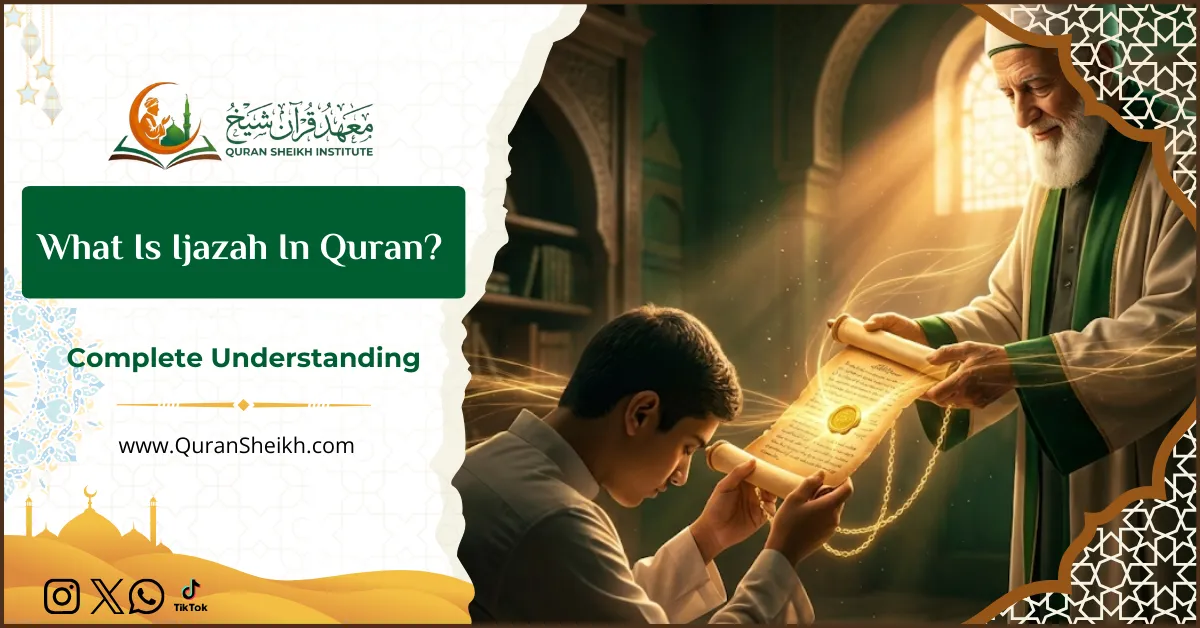
Many students finish hifz course or Tajweed studies and then hear one common question from teachers and institutes: Do you have an Ijazah? This happens in real settings—online classes, mosque circles, or when applying to teach the Quran. An Ijazah in the Quran is an official permission given by a qualified Quran teacher. It confirms that a student has recited the Quran correctly, with proper Tajweed, from start to end, directly to that teacher. This chain links back to the Prophet ﷺ, which makes it deeply reliable and respected.
An Ijazah is not a certificate for display. It is proof of accuracy, trust, and responsibility. It shows the student learned the Quran in the right way and can now teach others with confidence and correctness.
💡 Key Takeaways: Understanding Quran Ijazah
- True Definition: An Ijazah is an official permission from a qualified teacher, proving mastery and linking your recitation directly to the Prophet ﷺ.
- The Power of Sanad: Every authentic Ijazah includes a continuous chain of transmission (Sanad) that preserves the integrity of the Quran across generations.
- Multiple Categories: Ijazah isn’t one-size-fits-all; specific types are granted for Hifz, Tajweed, Recitation, and Qira’at based on the student’s mastery.
- Authority to Teach: Unlike standard completion certificates, earning an Ijazah gives you the recognized trust and permission to teach the Quran to others.
What Is Ijazah in the Quran?
Ijazah in the Quran is an official permission given by a qualified teacher to a student who has learned the Quran properly. It shows that the student can recite the Quran correctly, with accurate Tajweed, and has learned from the teacher directly. This permission is not just a certificate—it represents trust and authenticity. Through Ijazah, the student becomes part of a chain of teachers and learners that goes back to the Prophet ﷺ.
Ijazah also gives students the right to teach others. It confirms they have reached a level of mastery where they can guide others without mistakes. For anyone serious about learning or teaching the Quran, Ijazah is considered an essential step in building credibility and respect in the Islamic community.
Get a customized memorization plan and 1-on-1 guidance from expert Azhari tutors.
Importance of Ijazah in Quran Learning
Ijazah holds a unique place in Quran education because it guarantees that the Quran is learned and passed on correctly. Without Ijazah, a student may recite well but lacks official recognition and connection to authentic teaching chains. This can create doubts about the accuracy of recitation.
The importance of Ijazah includes:
- Authenticity: Confirms the student learned from a verified teacher.
- Trust: Shows the student can teach others with confidence.
- Preservation: Helps maintain the original recitation style and pronunciation across generations.
For students and teachers alike, Ijazah is more than a document. It is a responsibility to continue the Quran’s accurate transmission. It builds credibility for teaching and ensures the spiritual and academic integrity of Quran education.
The Role of Sanad in Ijazah
Sanad is the chain of teachers and students that links a Quran learner back to the Prophet ﷺ. It is a core part of Ijazah because it ensures the Quran is transmitted correctly and without mistakes. Every Ijazah comes with a sanad, showing exactly who taught whom. This chain is important for maintaining the authenticity of recitation across generations.
Sanad gives learners confidence that they are learning the Quran as it was revealed. It also allows future teachers to trace back the recitation line to verify its accuracy. In short, sanad preserves the integrity of Quran teaching and strengthens the spiritual connection between teacher and student.
Types of Ijazah
Ijazah is not one-size-fits-all. There are specific types depending on what a student has mastered. The main types include:
- Recitation Ijazah: This confirms the student can recite the Quran correctly with proper Tajweed. It focuses on accuracy in pronunciation and following all recitation rules.
- Hifz (Memorization) Ijazah: Given to students who have memorized the Quran fully. It proves they can recite the entire Quran from memory without mistakes.
- Tajweed Ijazah: This shows the student has mastered the rules of Tajweed, including elongation (Madd), Qalqalah, stops, and correct pronunciation of letters.
- Qira’at Ijazah: This is a specialized Ijazah for the different recognized methods of recitation (Qira’at). It is usually earned after advanced study and shows proficiency in a particular style.
Each type of Ijazah serves a unique purpose. Some students earn more than one type, especially if they are planning to teach. Possessing the right Ijazah ensures trust, authority, and correctness in both personal recitation and teaching others.
Who Can Grant an Ijazah?
An Ijazah can only be granted by a qualified Quran teacher, often called a Sheikh or Ustaadh, who themselves has an authentic Ijazah. This ensures that the teaching chain is unbroken and trustworthy. The teacher must be highly skilled in Quran recitation, Tajweed rules, and sometimes in Qira’at (different recitation styles).
Not all teachers can give Ijazah. Only those recognized by Islamic scholars or institutions are authorized. This protects the accuracy of Quran transmission and maintains the credibility of reciters. For students, verifying a teacher’s credentials and learning lineage is essential before seeking Ijazah.
Requirements to Obtain an Ijazah
Obtaining Ijazah is not automatic; students must meet specific standards:
- Correct Recitation: The student must recite the Quran accurately, following all Tajweed rules.
- Memorization (if Hifz Ijazah): Complete memorisation of the Quran without errors is required for Hifz Ijazah.
- Understanding of Rules: For Tajweed or Qira’at Ijazah, the student must demonstrate mastery of pronunciation, elongation, and stops.
- Consistent Practice: Regular revision and practice are necessary to maintain perfection.
- Teacher Assessment: The student must recite directly to the teacher for verification, usually in sessions that continue until mastery is confirmed.
Meeting these requirements shows commitment, discipline, and respect for Quranic teaching traditions.
Step-by-Step Process to Get an Ijazah
- Choose a Qualified Teacher: Ensure the teacher has an authentic Ijazah and recognized expertise.
- Learn and Practice: Study Quran recitation or memorisation under the teacher’s supervision.
- Regular Revision: Review sections daily and clarify doubts with the teacher.
- Evaluation Sessions: Recite portions of the Quran in front of the teacher for correction.
- Final Assessment: Once the teacher is satisfied with accuracy, the student may be granted Ijazah.
- Issuance of Ijazah: The teacher records the student’s name, type of Ijazah, and learning chain, officially granting permission to teach others.
Ijazah vs Quran Certificate and Online Options
While both Ijazah and Quran certificates acknowledge learning, there are key differences:
| Feature | Ijazah | Quran Certificate |
| Purpose | Proof of mastery and permission to teach | Proof of course completion |
| Authority | Granted by qualified scholars/Sheikhs | Issued by institutes or online platforms |
| Authenticity | Linked to a continuous chain (Sanad) | Usually not linked to a teaching chain |
| Focus | Recitation accuracy, Tajweed, memorization | Attendance and participation |
| Teaching Permission | Allowed to teach others | Usually not valid for teaching |
| Online Availability | Some online Ijazah programs exist, must verify teacher credibility | Widely available online |
Online Ijazah course have become popular, but students must confirm the teacher’s qualifications. Choosing trusted platforms ensures authenticity and maintains the spiritual and scholarly integrity of Ijazah.
Final Words
Obtaining an Ijazah ensures your Quran recitation is accurate, authentic, and connected to a trusted teaching chain. It is a mark of mastery, discipline, and responsibility, allowing you to confidently teach others. Albeit for personal growth or teaching, Ijazah preserves the Quran’s true form across generations.
Start your journey with Quran Sheikh, where qualified egyption quran teachers guide you step by step, helping you earn an authentic Ijazah and build a lifelong, meaningful connection with the Quran.
Common Questions About Ijazah in the Quran
What exactly is an Ijazah in Quran studies?
An Ijazah is an official permission given by a qualified teacher confirming that a student has recited the Quran correctly, with proper Tajweed, directly to that teacher, linking back through a chain to the Prophet.
What are the main types of Ijazah?
The four main types are Recitation Ijazah for correct Tajweed, Hifz Ijazah for full memorization, Tajweed Ijazah for mastering pronunciation rules, and Qira’at Ijazah for specialized recitation methods.
What is a Sanad, and why does it matter for an Ijazah?
A Sanad is the chain of teachers and students linking a learner back to the Prophet. It ensures the Quran is transmitted correctly and lets future teachers verify the accuracy of a recitation line.
Who is qualified to grant an Ijazah?
Only a qualified Quran teacher, often called a Sheikh or Ustaadh, who themselves holds an authentic Ijazah recognized by Islamic scholars or institutions can grant one to a student.
How is an Ijazah different from a regular Quran course certificate?
An Ijazah proves mastery and grants permission to teach others through a verified chain of transmission, while a standard certificate mainly confirms course attendance and is usually not valid for teaching.