
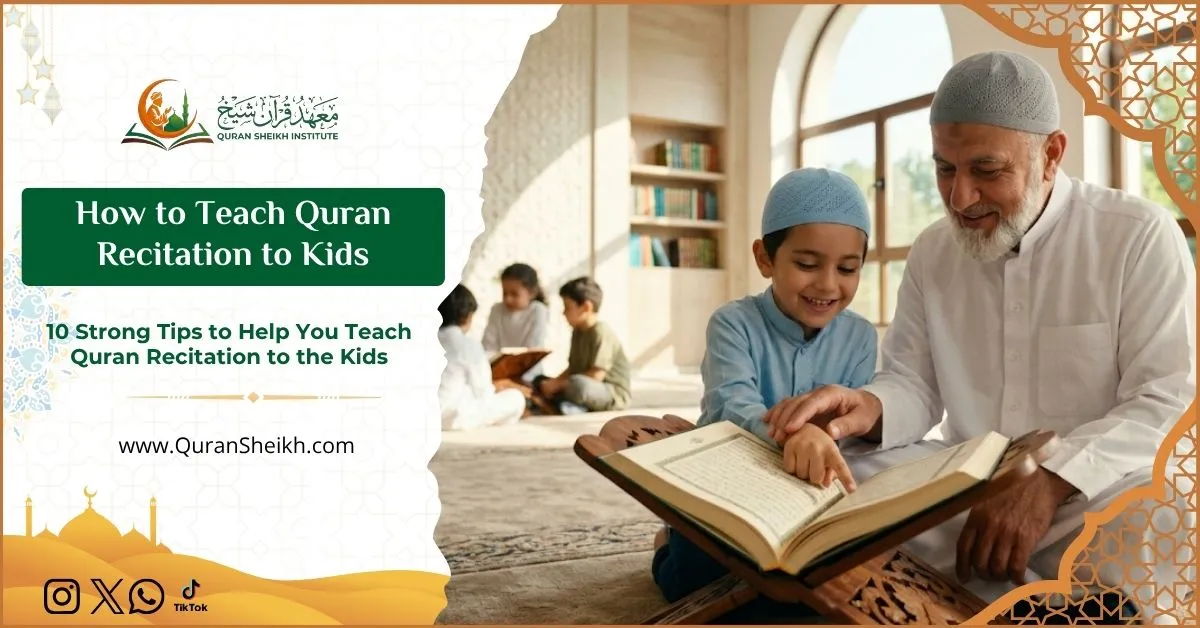
A strong Quran recitation habit grows when kids hear the Quran regularly and practice with consistency. Quran classes for kids provide structured learning with clear teacher guidance, helping young learners build confidence in their recitation. Short surahs, step-by-step lessons, and age-appropriate teaching methods make recitation easier and more enjoyable. In addition, children improve faster when lessons match their age, focus level, and memory ability. Proper recitation training also builds a solid foundation for Tajweed and future Hifz course learning.
💡 Key Takeaways: 10 Tips to Teach Quran Recitation to Kids
- Correct Just One Sound at a Time During Shared Reading: When reading together, a parent should let the child repeat a full phrase and then gently correct only a single mispronounced letter, not multiple mistakes at once.
- Don’t Interrupt After Every Small Slip During Repetition: Instead, repeat the correct sound yourself and let the child copy it again naturally, since constant interruption breaks flow and confidence more than it fixes pronunciation.
- Introduce Heavy Letters Only After the Easy Ones Feel Solid: Sounds like ع, ح, ق, ص, ض, ط, and ظ should come after a child is comfortable with simpler letters, since rushing into these too early often causes lasting confusion.
- Keep the Same Reciter and Same Surah for Several Days Straight: Repeating the identical audio and Surah, rather than rotating through different ones, helps a child recognize rhythm and words naturally before moving forward.
10 Strong Tips to Help You Teach Quran Recitation to the Kids
1. Start With Daily Quran Listening at Home
Daily Quran listening helps children become familiar with the sound, flow, and beauty of recitation before they read on their own. As a parent, play short and clear recitation at a calm time, such as after Fajr, before sleep, or during quiet play.
Keep it simple at the start.
- Choose one short surah for a few days.
- Use the same reciter for consistency.
- Keep listening time around 5–10 minutes.
Over time, the child begins to recognize words, rhythm, and pauses naturally.
Join 500+ families learning 1-on-1 with certified Azhari Tutors.
2. Teach Arabic Letters Via Noorani Qaida
Noorani Qaida for kids helps children learn Arabic letters, sounds, joining, vowels, and basic reading step by step. So, before asking a child to read Quran verses, guide them through the Qaida with patience and clear correction.
| Learning Step | What Child Learns | Parent’s Role |
| Letters | Shape and sound | Repeat slowly |
| Harakat | Fatha, kasrah, dammah | Give easy examples |
| Joining | Connected letters | Read with the child |
| Short words | Basic reading | Correct gently |
A strong Qaida base makes Quran recitation easier and more accurate later.
3. Use Slow and Clear Quran Recitation for Kids
Children need slow and clear recitation because they are still learning how Arabic letters sound. Fast recitation can make it hard for them to hear each letter, vowel, and pause correctly. So, always begin with a calm pace.
Ask the child to listen first, then repeat one small part after you or the teacher. For example, practice one ayah from Surah Al-Fatihah instead of the full surah at once. Slow recitation helps the child build clarity, confidence, and better Tajweed habits from the beginning.
4. Create a Consistent Daily Quran Reading Routine
A daily Quran routine teaches children that recitation is a normal part of life, not a heavy task. Parents should choose a fixed time when the child is fresh, calm, and not rushed.
A simple routine can look like:
- 5 minutes listening
- 5 minutes Noorani Qaida or reading
- 2 minutes revision
Keep the lesson short but regular. For young kids, a small daily session is usually better than one long weekly lesson. With steady practice, children remember better and feel less pressure during Quran learning.
5. Encourage Kids to Repeat Verses by Listening
Repetition is one of the easiest ways for children to improve Quran recitation. First, let the child listen to one short verse several times. Then, ask them to repeat after the reciter, teacher, or parent in a soft and calm way.
Do not rush correction after every small slip. Instead, repeat the correct sound and let the child copy it again. For example, one verse can be practiced 3–5 times in one sitting. Regular repetition improves memory, pronunciation, and fluency step by step.
6. Read the Quran Together With Children Regularly
Reading with your child makes Quran recitation feel guided, safe, and easier. Sit beside them, point to each word, and let them follow with their eyes. Then read one short line and ask them to copy you.
A simple cue is: “Listen first, look at the word, then read slowly.” For example, while reading Surah Al-Ikhlas, guide the child word by word instead of asking for the full surah at once.
- Parent reads: قُلْ هُوَ اللهُ أَحَدٌ
- Child repeats the same part
- Parent gently corrects one sound only
Regular shared reading builds focus, love, and confidence.
7. Build a Calm and Quran-Focused Learning Environment
Children learn Quran recitation better when the place is quiet, clean, and free from distractions. Choose one fixed corner at home for Quran time. Keep the Mushaf, Noorani Qaida, and water nearby, so the child does not keep moving around.
Use soft cues before starting, such as “Now we will read calmly for Allah’s words.” Keep phones, TV, toys, and loud sounds away during the lesson.
A good Quran environment may include:
- A fixed reading place
- A short learning time
- Gentle parent support
- Praise after effort
A peaceful setup helps the child connect Quran learning with comfort, not pressure.
8. Use Short Surahs for Early Recitation Practice
Short surahs are best for early Quran recitation because children can hear, repeat, and remember them more easily. Start with surahs from Juz Amma, such as Surah Al-Fatihah, Al-Ikhlas, Al-Falaq, An-Nas, Al-Kawthar, or Al-Asr.
Teach one small part at a time. For example, in Surah An-Nas, practice “قُلْ أَعُوذُ بِرَبِّ النَّاسِ” until the child can say it clearly before moving ahead.
| Surah | Ayahs | Good Practice Focus |
| Al-Ikhlas | 4 | Clear short verses |
| Al-Falaq | 5 | Slow repetition |
| An-Nas | 6 | Ending sounds |
| Al-Kawthar | 3 | Fluency |
9. Help Kids Learn Correct Pronunciation Step by Step
Correct pronunciation should be taught slowly because Arabic letters have different mouth and throat positions. Do not expect a child to master all letters quickly. Start with easy letters, then move to harder sounds like ع, ح, ق, ص, ض, ط, and ظ.
Use clear cues. For example:
- Say “ق” from deeper in the mouth, not like “ك”.
- Say “ح” with an open throat sound, not like “ه”.
- Say “ص” with a heavier sound than “س”.
Correct one sound at a time during recitation. Gentle correction protects accuracy and keeps the child confident.
10. Choose Qualified Quran Teachers for Proper Recitation Guidance
A qualified Quran teacher helps children learn recitation with correct pronunciation, Tajweed basics, and regular correction. Parents can support at home, but a trained teacher can hear small mistakes that parents may miss.
Look for a teacher who reads slowly, corrects gently, and explains sounds in a child-friendly way. For example, the teacher should show how to stretch Madd, where to pause, and how to pronounce letters from their right place.
Good signs of a suitable teacher include:
- Clear Tajweed knowledge
- Patient correction
- Short child-friendly lessons
- Regular revision
- Progress updates for parents
Proper guidance builds a strong base for accurate recitation and future Hifz course for kids.
Final Words
Teaching Quran recitation to kids needs patience, consistency, and a peaceful learning environment. Children learn better through listening, repetition, slow reading, and gentle correction.
Parents who build daily Quran habits early often help children develop stronger pronunciation, confidence, and love for the Quran. Quran Sheikh provides structured Quran learning support in online quran classes to help kids improve recitation step by step.