
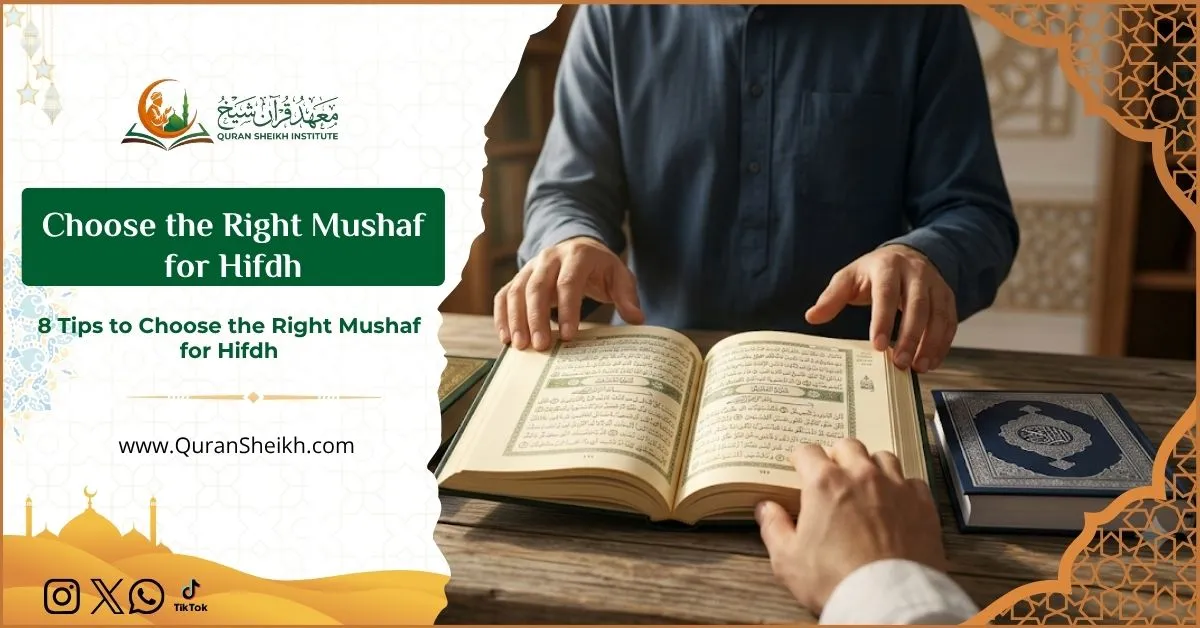
Choosing the right Mushaf for Hifz means selecting a Quran copy that makes reading, memorizing, and revising easier. The best Mushaf usually has clear Arabic text, a familiar page layout, suitable print size, and strong binding. Using the same copy daily also helps the mind remember where verses appear on each page. However, every learner has different needs based on eyesight, age, reading level, and study method. Some prefer the 15-line Madani Mushaf, while others need larger text or color-coded Tajweed rules.
💡 Key Takeaways: 8 Tips to Choose the Right Mushaf for Hifdh
- Test the Mushaf for 10 to 15 Minutes Before Committing: Reading under normal light for this long reveals whether the font size, paper color, and vowel marks stay comfortable during a real study session, not just a quick glance.
- A 15-Line Layout Is the Traditional Choice for Page-Based Hifz: Most 15-line Mushafs end each page at the close of an ayah, which lines up naturally with page-by-page memorization plans.
- Never Switch Editions Mid-Journey: Since the mind learns to associate each verse with its exact position on the page, changing to a different layout disrupts that visual memory built over months.
- Prioritize Binding Strength Over Appearance: A Mushaf opened many times daily needs sewn binding that lies flat without cracking, since a loosening spine becomes a real problem for a book used this often.
8 Tips to Choose the Right Mushaf for Hifdh
1. Choose a Mushaf With a Clear and Familiar Arabic Script
Choose a script that you can read without stopping often. Many learners use the Uthmani script because it is common in Madani Mushafs and is widely used for Quran study. However, some readers may be more comfortable with Indo-Pak script because they learned Quran reading through it.
Before buying, read one full page and check whether the letters, vowel marks, and stopping signs are easy to see. Also, ask your Hifdh teacher which script is used during lessons.
- Use the script you already read well.
- Avoid changing scripts during Hifz.
- Check that all marks are printed clearly.
Get a customized memorization plan and 1-on-1 guidance from expert Azhari tutors.
2. Select the Right Number of Lines Per Page
The number of lines on each page affects how you divide and remember your daily lesson. A 15-line Mushaf is widely used for quran Hifz because each page usually ends at the end of an ayah. Other Mushafs may have 13, 16, or more lines per page.
| Lines Per Page | Suitable For |
| 15 lines | Traditional Hifz plans and page-based memorisation |
| 13 lines | Learners who prefer larger text |
| 16 lines | Readers already familiar with that layout |
Choose one layout with your teacher, then keep using it. A fixed line pattern supports steady page memory during revision.
3. Use a Mushaf With a Consistent Page Layout
A consistent page layout helps you remember where each ayah appears. For example, you may recall that a verse starts near the top, middle, or bottom of the page. That visual link can support memorization and revision.
Therefore, choose a Mushaf in which:
- Every Juz follows the same page style.
- Text begins and ends in a regular way.
- Page numbers and section marks are easy to find.
Avoid switching between printed copies with different layouts. Even when the Quranic text is the same, the position of verses may change from one edition to another. Use one main Mushaf throughout Hifz whenever possible.
4. Pick a Suitable Font Size for Comfortable Reading
The font should be large enough to read clearly during long Hifdh and revision sessions. Very small text may make vowel marks harder to see, especially for children, older learners, or anyone with weak eyesight. However, very large print can make the Mushaf heavier and less easy to carry.
Read from the Mushaf for 10 to 15 minutes before choosing it. Check whether you can see the letters, dots, Tajweed signs, and stopping symbols without moving the page too close.
5. Choose Paper Color That Reduces Eye Strain
Paper color affects how comfortable the Mushaf feels during long reading sessions. Bright white pages may reflect more light, while cream or light yellow pages can feel softer to some readers. However, comfort depends on eyesight, room lighting, and personal preference.
Before choosing, read for 10 to 15 minutes under normal study light. Check whether the Arabic text remains clear and whether your eyes feel comfortable.
- Choose paper with clear contrast between text and background.
- Avoid pages that are too glossy or reflective.
- Make sure vowel marks remain easy to see.
6. Select a Strong Binding for Daily Hifz Use
A Hifz Mushaf is opened many times each day, so the binding should be strong enough for regular use. Weak glue binding may loosen over time, especially when the Mushaf is carried often. Sewn binding is usually more durable and allows pages to open more easily.
Check whether the cover, spine, and pages feel secure before buying. Also, open the Mushaf near the beginning, middle, and end to see whether it stays open comfortably.
- Choose a firm cover for daily travel.
- Check that pages are attached evenly.
- Avoid bindings that crack when opened.
7. Match the Mushaf Size With Your Study Routine
Choose a Mushaf size that fits where and how you study. A medium-sized Mushaf often works well for home, class, and daily travel. A large Mushaf gives clearer text but may be heavy, while a pocket-sized copy is easy to carry but may have smaller writing.
Think about your normal routine before buying. For example, a student who studies mostly at home may prefer a larger copy, while someone who revises during travel may need a lighter one.
Try holding and reading the Mushaf for several minutes. The right size should feel comfortable, easy to carry, and suitable for regular revision.
8. Use the Same Mushaf Throughout Your Hidh Journey
Using one Mushaf helps build visual memory. Over time, you may remember whether an ayah appears at the top, middle, or bottom of a page. Changing to another edition can move the verses to different positions and may disturb that mental picture.
Therefore, choose carefully at the beginning and continue with the same page layout during memorisation and revision.
- Keep one main Mushaf for daily Hifz.
- Replace it only with the same edition and layout.
- Use digital copies only when they match your printed Mushaf.
Final Words
Choosing the right Mushaf can make Hifz more comfortable, organized, and consistent. Focus on clear script, suitable lines, readable font, calm paper color, strong binding, and practical size. Most importantly, continue using the same layout. Quran Sheikh can guide learners toward a steady and suitable memorization routine.
Common Questions About Choosing a Mushaf for Hifz
Why is a 15-line Mushaf commonly recommended for Hifz?
A 15-line Mushaf is widely used for Quran Hifz because each page usually ends at the end of an ayah, which supports page-based memorization and makes daily targets easier to track consistently.
Why does switching between different Mushaf editions cause problems during Hifz?
Even when the Quranic text is identical, the position of verses can shift between editions with different layouts. Using one consistent Mushaf throughout Hifz helps build visual memory of where each ayah appears on the page.
How can a student test if a Mushaf’s font size is comfortable before buying it?
Read from the Mushaf for 10 to 15 minutes before choosing it, checking whether the letters, dots, Tajweed signs, and stopping symbols remain clear without needing to move the page too close.
What type of binding is best for a Mushaf used daily during Hifz?
Sewn binding is usually more durable than weak glue binding, since a Hifz Mushaf is opened many times each day. Check that the cover, spine, and pages feel secure, and that it opens comfortably near the beginning, middle, and end.
Does the color of the Mushaf’s paper matter for long memorization sessions?
Yes, paper color affects comfort during long sessions. Bright white pages can reflect more light, while cream or light yellow pages may feel softer to some readers, though comfort ultimately depends on personal eyesight and room lighting.