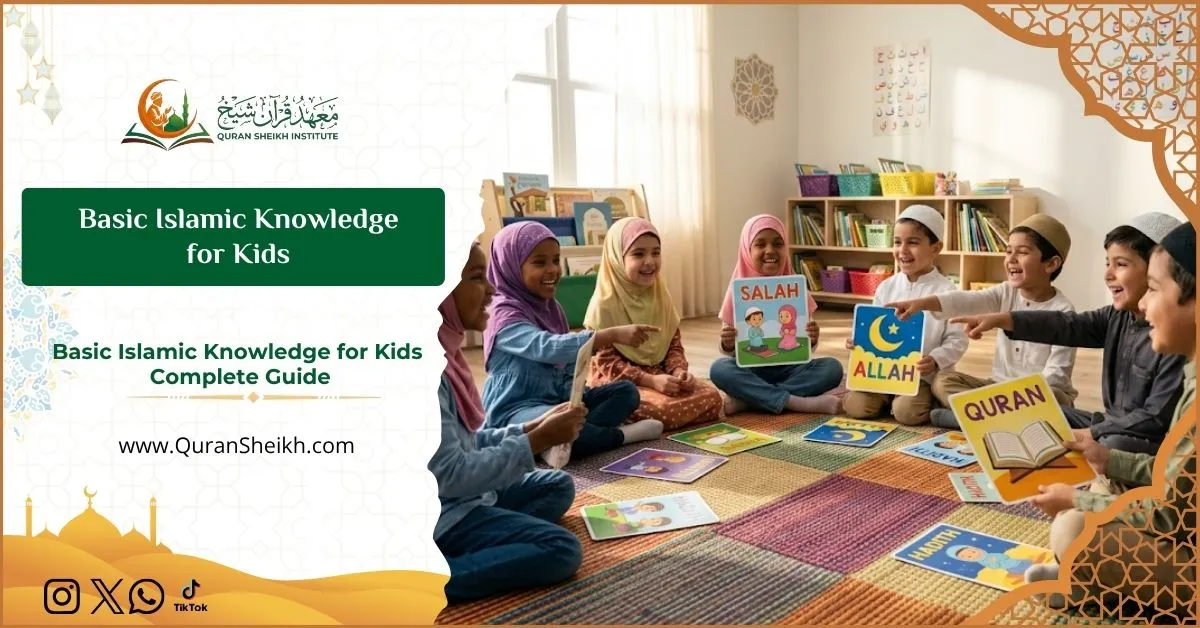
Basic Islamic knowledge helps kids learn who Allah is, how to pray, and how to follow good manners in daily life. It includes simple lessons about the Quran, the Five Pillars of Islam, duas, honesty, kindness, and respect for others. Early Islamic learning also builds strong habits that stay with children as they grow.
Parents and teachers play an important role in making Islamic education easy and enjoyable for kids. Simple stories, daily practice, and Quran learning can help children understand Islam step by step. A complete guide to basic Islamic knowledge for kids and engaging Islamic studies for kids gives families a clear way to teach faith, character, and love for Islam from an early age.
💡 Key Takeaways: Basic Islamic Knowledge for Kids: Complete Guide
- Wudu Follows a Fixed 10-Step Sequence for Kids to Learn: From making the intention and saying Bismillah, through washing hands, mouth, nose, face, arms, wiping the head, cleaning ears, and finally the feet, in set order.
- Seven Islamic Months Each Carry Their Own Named Event: From Muharram marking the Islamic New Year through Dhul Hijjah bringing Hajj and Eid al-Adha, each month in the calendar ties to a specific occasion kids can recognize.
- Daily Duas Are Taught in Matched Pairs, One for Each Routine Moment: Waking up, eating, sleeping, entering the home, and leaving the home each get their own short paired dua, linking words directly to an action a child already does.
- A Simple Daily Routine Threads 12 Small Islamic Habits Together: From the morning dua through Fajr, Quran, kind speech, daily Salah, helping parents, and the bedtime dua, the whole day becomes a chain of small consistent practices.
What Is Basic Islamic Knowledge for Kids?
Basic Islamic knowledge for kids means teaching children the main lessons of Islam in a simple and easy way. It includes learning about Allah, Prophet Muhammad ﷺ, the Quran, prayer, good manners, and daily Islamic habits. Muslim children should also know the Five Pillars of Islam and the difference between right and wrong in Islam.
Kids learn Islam step by step through short lessons, duas, Quran reading, and daily practice. Early Islamic learning helps children grow with strong faith, respect, kindness, and love for Allah. It also helps them build a close connection with the Quran from a young age.
Why Kids Should Learn Islam Early
Children learn quickly during their early years. Teaching Islam at a young age helps them understand their religion before they grow older.
Simple Islamic lessons also help kids develop good manners, honesty, patience, and respect for others. Learning Islam early makes it easier for children to pray, read the Quran, and follow Islamic teachings in daily life.
Build a Strong Islamic Foundation for You & Your Family!
Learn Aqeedah, Fiqh, Seerah, and Islamic morals 1-on-1 with certified Azhari scholars.
Belief in Allah for Kids
The first thing Muslim kids should learn is belief in Allah. Muslims believe Allah is the One Creator who made the heavens, the earth, people, animals, and everything around us. Allah sees everything, knows everything, and cares for His creation. Muslims worship only Allah and ask Him for help.
Allah says in the Quran:
“Allah is the Creator of all things, and He is, over all things, Disposer of affairs.” (Surah Az-Zumar 39:62)
Learning About Prophet Muhammad ﷺ
Prophet Muhammad ﷺ is the final Prophet of Islam. Muslim kids should learn about his life, character, kindness, and teachings.
Children can learn simple facts about Prophet Muhammad ﷺ such as:
- He was born in Makkah
- He was known for honesty and kindness
- Allah chose him as the last Prophet
- He received the Quran through Angel Jibreel
- He loved children and treated them gently
- He taught Muslims how to pray and live a good life
Muslim children should also learn to say “ﷺ” after hearing or saying the Prophet’s name as a sign of respect and love.
The Five Pillars of Islam
The Five Pillars of Islam are the main acts of worship every Muslim should know. These pillars help Muslims build strong faith and practice Islam in daily life. Teaching these pillars to kids helps them understand the foundation of Islam in a simple way.
1. Shahadah
Shahadah means believing and saying that there is no god except Allah and Prophet Muhammad ﷺ is the Messenger of Allah. It is the first and most important pillar of Islam. A person becomes Muslim by sincerely believing and saying the Shahadah.
The Shahadah is:
“La ilaha illallah, Muhammadur Rasulullah”
“There is no god but Allah, and Muhammad is the Messenger of Allah.”
2. Salah
Salah is the daily prayer Muslims perform five times every day. Muslims pray to worship Allah, thank Him, and ask Him for guidance. Prayer teaches discipline, cleanliness, patience, and obedience to Allah.
Allah says in the Quran:“Indeed, prayer has been decreed upon the believers a decree of specified times.” (Surah An-Nisa 4:103)
3. Fasting in Ramadan
Muslims fast during the month of Ramadan from dawn until sunset. During fasting, Muslims do not eat or drink during the day. Fasting teaches patience, self-control, gratitude, and care for poor people.
Allah says in the Quran:
“O you who believe, fasting is prescribed for you as it was prescribed for those before you so that you may become righteous.” (Surah Al-Baqarah 2:183)
4. Zakat
Zakat means giving part of one’s wealth to poor and needy people. It teaches Muslims kindness, sharing, and helping others. Adult Muslims who have enough money must give Zakat once every year.
Allah says in the Quran:
“And establish prayer and give Zakat.” (Surah Al-Baqarah 2:110)
5. Hajj
Hajj is the pilgrimage to Makkah that Muslims perform once in their lifetime if they are able. Millions of Muslims travel to the Kaaba and perform special acts of worship during the Islamic month of Dhul Hijjah.
Allah says in the Quran:
“And [due] to Allah from the people is a pilgrimage to the House — for whoever is able to find thereto a way.” (Surah Aal-E-Imran 3:97)
Basic Quran Knowledge for Kids
Basic Quran knowledge helps Muslim kids learn how to read, understand, and respect the Quran. Children should begin with simple lessons and practice daily with parents or teachers in quran classes for kids.
Kids should learn:
- The Quran is the holy book of Islam
- Allah revealed the Quran to Prophet Muhammad ﷺ
- Angel Jibreel brought the Quran
- The Quran is written in Arabic
- Muslims read the Quran with respect and cleanliness
- Short Surahs are easier for beginners to memorize
- Tajweed helps Muslims read the Quran correctly
- Daily Quran reading brings rewards and blessings
- Memorizing the Quran is a special act in Islam
- The Quran teaches good manners and right actions
Basic Duas Every Muslim Kid Should Know
Muslim kids should learn simple daily duas to remember Allah throughout the day. Small duas help children build strong Islamic habits from an early age.
- Before Eating
- Dua: “Bismillah”
- Meaning: “In the name of Allah”
- After Eating
- Dua: “Alhamdulillah”
- Meaning: “All praise is for Allah”
- Before Sleeping
- Dua: “Bismika Allahumma amutu wa ahya”
- Meaning: “O Allah, in Your name I die and I live”
- After Waking Up
- Dua: “Alhamdulillahil-ladhi ahyana”
- Meaning: “Praise be to Allah who gave us life”
- Entering the Home
- Dua: “Bismillahi walajna wa bismillahi kharajna”
- Meaning: “In the name of Allah we enter and leave”
- Leaving the Home
- Dua: “Bismillahi tawakkaltu ‘alallah”
- Meaning: “In the name of Allah, I trust Allah”
- Before Studying
- Dua: “Rabbi zidni ilma”
- Meaning: “My Lord, increase me in knowledge”
- For Parents
- Dua: “Rabbir hamhuma kama rabbayani saghira”
- Meaning: “My Lord, have mercy upon them as they raised me when I was small”
Daily Islamic Manners for Kids
| Islamic Manners | What Kids Should Do |
| Respecting Parents | Listen to parents, speak politely, and help at home |
| Speaking Kindly | Use gentle words and avoid hurting others |
| Telling the Truth | Always speak honestly and avoid lying |
| Cleanliness in Islam | Keep clothes, body, and surroundings clean |
| Saying Salam | Greet Muslims with “Assalamu Alaikum” |
| Sharing With Others | Share toys, food, and help friends |
| Respecting Elders | Speak respectfully to older people |
| Good Table Manners | Eat with the right hand and say Bismillah |
| Being Thankful | Thank Allah and thank people for kindness |
| Helping Others | Support family, friends, and people in need |
Wudu Step by Step for Kids
- Make intention for Wudu
- Say “Bismillah”
- Wash both hands three times
- Rinse the mouth three times
- Clean the nose three times
- Wash the face three times
- Wash both arms up to elbows three times
- Wipe the head once
- Clean both ears
- Wash both feet up to ankles
Halal and Haram for Kids
| Halal (Allowed in Islam) | Haram (Not Allowed in Islam) |
| Speaking truthfully | Lying |
| Respecting parents | Disobeying parents |
| Eating halal food | Eating pork |
| Helping others | Hurting others |
| Praying Salah | Missing prayers without reason |
| Reading the Quran | Making fun of Islam |
| Being clean | Using bad language |
| Giving charity | Stealing |
| Sharing with friends | Bullying others |
| Saying kind words | Backbiting and insulting |
Islamic Months and Important Islamic Events
| Islamic Month | Important Event |
| Muharram | Islamic New Year |
| Rabi al-Awwal | Birth of Prophet Muhammad ﷺ |
| Rajab | Special month of worship |
| Sha’ban | Preparation for Ramadan |
| Ramadan | Month of fasting and Quran |
| Shawwal | Eid al-Fitr |
| Dhul Hijjah | Hajj and Eid al-Adha |
Simple Islamic Routine for Muslim Kids
- Wake up and say the morning dua
- Pray Fajr with parents if possible
- Read or memorize a small part of the Quran
- Say Bismillah before eating breakfast
- Speak kindly to family and friends
- Study and learn useful knowledge
- Pray the daily Salah on time
- Help parents at home
- Make dua during the day
- Read short Surahs before sleeping
- Say the bedtime dua
- Sleep with a clean heart and good intentions
Final Words
Teaching basic Islamic knowledge to kids helps them grow with strong faith, good manners, and love for the Quran. Simple daily learning can guide children throughout their lives and build a close connection with Islam from an early age. Join Quran Sheikh Islamic classes for kids to help your child learn Quran, duas, Salah, and Islamic values step by step.