
The Muscle of the Quran: Adding Emphasis 💪
Welcome to Lesson 12. You have learned the “Stop” (Sukoon). Now, get ready for the “Double Hit”.
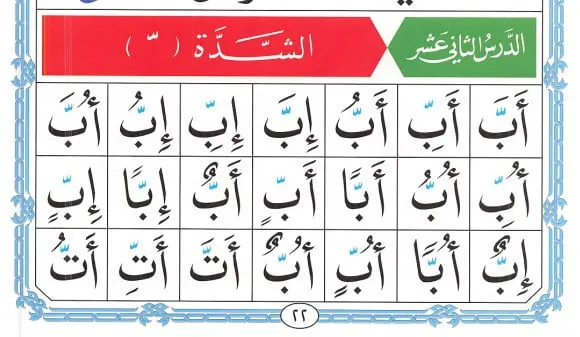
Shaddah ( ـّ ) looks like a small “w”. It turns a regular letter into a Strong Letter. It acts like a “Stapler” that connects two letters together: the first is stationary (Sukoon) and the second is moving.
Let’s build some Quranic strength! 👇
Abba
Atta
Ath-tha
Ajja
Ahha
Akh-kha
Adda
Ath-tha
Arra
Azza
🔵 Part 2: Shaddah + Kasra (Down)
Hold tight, then drop down! (Ab-bi)
Ibbi
Itti
Ith-thi
Ijji
Ihhi
Ikh-khi
Iddi
Ith-thi
🟢 Part 3: Shaddah + Damma (Round)
Hold tight, then circle lips! (Ab-bu)
Ubbu
Uttu
Uth-thu
Ujju
Uhhu
Ukh-khu
Uddu
Uth-thu
📺 Watch the Full Lesson: Listen & Repeat

🧬 The Mathematics of Shaddah
One symbol, two letters. Here is how it works.
Sound Effect: Imagine a car braking suddenly (Sukoon) and then accelerating again (Harakah). “Ab…ba”
💡 Golden Tips for Lesson 12
1. The “Nasal” Rule (Ghunnah) 👃
This is vital! If the Shaddah is on Noon ( نّ ) or Meem ( مّ ), you MUST hold the sound in your nose for 2 counts. It creates a beautiful buzz sound.
2. Don’t Bounce Qalqalah Yet
When you hit a Shaddah on a Qalqalah letter (like Tab-ba), don’t bounce the first part. Hold it tight (Tab…) then release the vowel (…ba).
3. The Timing is Key
A Shaddah letter takes longer than a single letter. Give it time! Rushing a Shaddah is a common mistake that changes the meaning.
📥 Take the Classroom Home
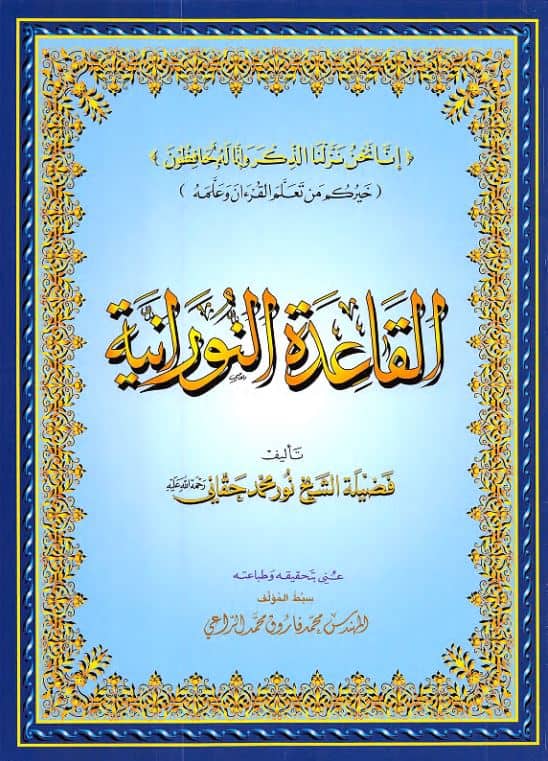
Download the Complete Noorani Qaida PDF (Free)
Don’t let the learning stop here. Get the exact book used by our Sheikhs. High-quality, clear script, and perfect for offline practice on any device.
- ✅ Crystal Clear Arabic Script
- ✅ Compatible with Mobile & Tablet
- ✅ 100% Free for Students
File size: Lightweight & Fast (PDF)
🎓 For Teachers: Advanced Insights
1. Nab’r (Accent) on Shaddah
2. Ghunnah Timing
Master the Art of Quran Recitation
Don’t rely on self-study alone. Get your pronunciation checked by a certified Al-Azhar Sheikh today.
- ✨ 1-on-1 Live Private Session
- ✨ Native Arab Tutors (Male & Female)
- ✨ 100% Free Evaluation – No Commitment
🔒 No Credit Card Required
💬 Common Questions About Lesson 11
Expert answers to master Sukoon exercises and fluency.
What is the main focus of Noorani Qaida Lesson 11?
Noorani Qaida Lesson 11 focuses on practicing Sukoon and everything learned in previous lessons, especially reading Arabic words without Hijja (spelling out each letter). It is a crucial lesson for Quranic fluency.
How are letters with a red color treated in Lesson 11?
In many Qaida prints, red letters indicate a special Tajweed rule. In the context of Sukoon exercises, they often highlight Qalqalah letters (Bounce) or sometimes heavy letters. You must pay extra attention to their pronunciation.
What is “Hijja” and why move beyond it?
“Hijja” is spelling out each letter (e.g., “Alif Fatha + Noon Sukoon = An”). The goal of Lesson 11 is to transition to “Rawan” (direct reading) to prepare you for reciting the Quran smoothly without pausing at every letter.
How do I read Hamzah Wasl (ٱ) at the start of a word?
If a word starts with Hamzah Wasl (like Ihdina):
1. If followed by Lam, use Fatha (Al-).
2. Otherwise, look at the 3rd letter: If it has Damma, use Damma (Ukh-ruj). If it has Fatha/Kasra, use Kasra (Ith-hab).
What happens to Hamzah Wasl in the middle of speech?
It becomes silent. It is a “connecting bridge” that falls down when connected. For example, “Wa-Isma” is read as “Wasma”—you jump straight from the Waw to the Seen.
How to avoid “bouncing” non-Qalqalah letters?
This is a common mistake (e.g., saying “An-na” instead of “An”). To fix it, hold the sound of the Sukoon letter firmly like a brake. Do not let your tongue release or move until you say the next letter.
What is the best way to practice this long lesson?
Divide it into small sections. Practice one line at a time using the “Listen & Repeat” method with a qualified teacher or recording. Do not rush; accuracy in Sukoon is more important than speed.
You are Getting Stronger!
You have now learned how to add emphasis and weight to Arabic words. Without Shaddah, words sound weak and incorrect. You are now ready to practice this in real words!
🎓 Ready to Level Up?
Don’t just read alone. Join our live classes with expert Sheikhs.


