Introduction: The ‘Negotiation’ That Was Never an Option
Imagine the scene. The leaders of Quraysh, frustrated by the Prophet Muhammad’s (ﷺ) growing influence, come to him with what they believe is a “reasonable offer.” They propose a compromise: “O Muhammad! Let us worship your God for a year, and you worship our gods for a year.”
It was a political proposal, a negotiation designed to blur the lines and dilute the message. They thought they were offering a solution. But in Islam, in the core of our faith (Tawhid), there is no middle ground.
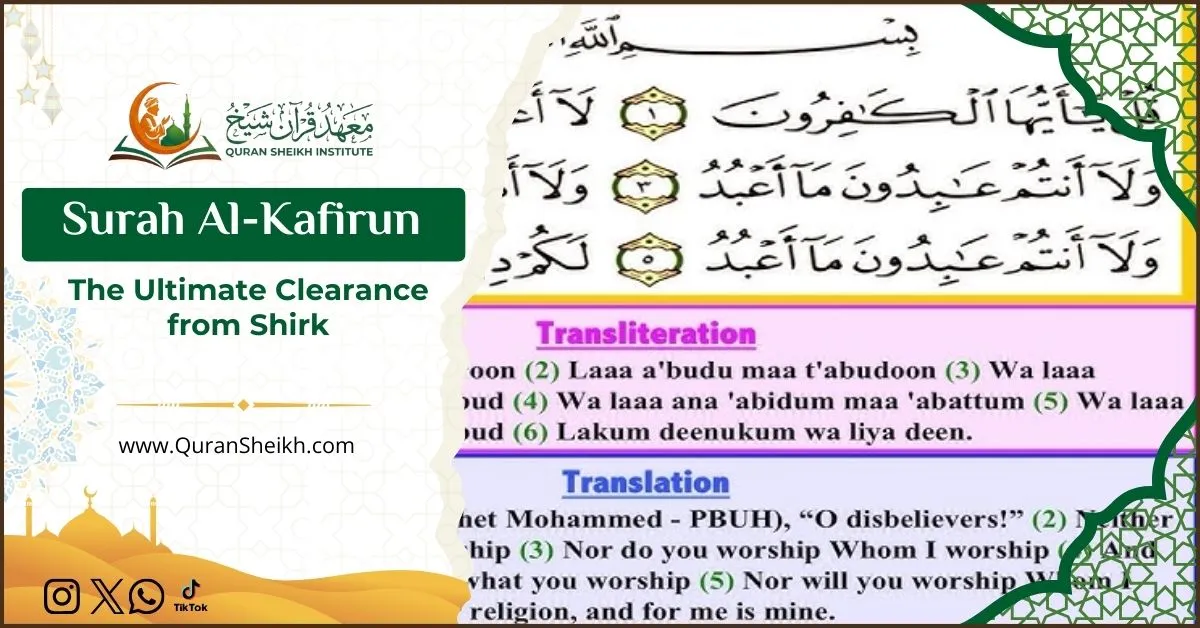
Allah’s response was not a counter-offer. It was not a debate. It was a complete, decisive, and eternal declaration sent down in six powerful verses: Surah Al-Kafirun (The Disbelievers).
This Meccan Surah is not a Surah of aggression; it is a Surah of integrity. It is the absolute line in the sand, and as the Prophet (ﷺ) taught us, it is a “clearance from shirk (polytheism).”
Listen to Al-Kafirun: Recitation by Sheikh Mishary Rashid Alafasy
Listen to this beautiful recitation to perfect your pronunciation and reflect on the meanings before reading the explanation.
The Anatomy of the Declaration: Understanding the 6 Verses
This Surah is a masterclass in clarity. Its power comes from its firm, repetitive, and unambiguous structure.
1. Qul yaa-ai yuhal Kafiroon (Say, “O disbelievers,)
- The Contemplation: The Surah begins with a command: “Qul” (Say!). This is not a private thought; it is a public, open, and clear declaration. It addresses the opposition directly, without hesitation.
2. Laa a’budu ma t’abudoon (I do not worship what you worship.) 3. Wa laa antum ‘aabidoona maa a’bud (Nor are you worshippers of what I worship.)
- The Contemplation (The Present Reality): This is the first set of declarations. It establishes the current state of affairs. “My path is not your path. My object of worship (Allah, The One) is not your object of worship (idols, desires). We are fundamentally different right now.”
4. Wa laa ana ‘abidum maa ‘abattum (Nor will I be a worshipper of what you worship.) 5. Wa laa antum ‘aabidoona ma a’bud (Nor will you be worshippers of what I worship.)
- The Contemplation (The Future Certainty): This is the crucial repetition. It seals the declaration for the future. “And I will never worship what you worship. This is not negotiable. It will not change.” This part obliterates the Quraysh’s proposal of “worshipping for a year.” It also confirms Allah’s divine knowledge that this specific group of leaders would never truly worship Him.
6. Lakum deenukum wa liya deen. (For you is your religion, and for me is my religion.)
- The Contemplation (The Final Separation): This is one of the most powerful verses in the Quran. It is not, as some misunderstand, an acceptance or validation of their religion. It is a “declaration of disavowal.” It means: “Your path of kufr (disbelief) is for you. My path of Islam (pure submission) is for me. The two shall never meet.” It is the ultimate statement of spiritual independence.
The Prophetic Power: A Quarter of the Quran & A Shield at Night
This Surah’s power is so immense that the Prophet (ﷺ) integrated it into his most important daily practices.
- A “Quarter” of the Quran: Just as Surah Al-Ikhlas (Tawhid) is equal to one-third, it is narrated that Surah Al-Kafirun is “equivalent to one-quarter of the Quran.” Why? Because the Quran’s message can be seen in four parts (Tawhid, Prophecies, Rulings, Stories), and Al-Kafirun represents the complete “disavowal of shirk,” a foundational pillar of the faith.
- The Prophetic Pair: The Prophet (ﷺ) frequently recited Al-Kafirun and Al-Ikhlas together in the two rak’ahs before the Fajr prayer and the two rak’ahs after Maghrib, as well as after the Tawaf of the Ka’bah. This is the perfect pairing: Al-Ikhlas is the affirmation of who we worship, and Al-Kafirun is the negation of what we do not worship. Together, they are the complete declaration of Tawhid.
- The Nightly Shield: Most importantly for our daily lives, the Prophet (ﷺ) advised: “Recite Surah Al-Kafirun and then go to sleep after coming to its end, for it is a clearance from shirk.” (Abu Dawud)
The Smart Bridge: From Recitation to an Unshakeable Identity
The “clearance from shirk” is not just about idols of stone. In our modern lives, we face our own “negotiations.” We are pressured to compromise our values, to water down our faith, or to prioritize worldly desires (money, status, acceptance) over the commands of Allah.
Reciting this Surah is a nightly purification. It is a powerful reminder to your own soul that you will not compromise your core beliefs.
But to live by this Surah—to have the unshakeable confidence to say “lakum deenukum wa liya deen”—you must have more than just a surface-level understanding. Your faith must be built on a foundation of deep, authentic knowledge. You must understand why you believe what you believe.
This is the journey from simple recitation to a profound, unshakeable Muslim identity. At Quran Sheikh online Quran learning, our expert tutors are dedicated to building this foundation with you. We specialize in teaching the deep Tawhid and Tafseer that empower you to stand firm in your faith with clarity and confidence.
Your Declaration of Spiritual Independence
Surah Al-Kafirun is your personal declaration of spiritual independence. It is the polite but non-negotiable line that protects your faith.
Let this Surah, recited each night, be your personal “clearance from shirk,” purifying your heart and renewing your singular devotion to Allah, The One.

For Reference: Transliteration and Translation
Qul yaa-ai yuhal Kafiroon (Say, “O disbelievers,)
Laa a’budu ma t’abudoon (I do not worship what you worship.)
Wa laa antum ‘aabidoona maa a’bud (Nor are you worshippers of what I worship.)
Wa laa ana ‘abidum maa ‘abattum (Nor will I be a worshipper of what you worship.)
Wa laa antum ‘aabidoona ma a’bud (Nor will you be worshippers of what I worship.)
Lakum deenukum wa liya deen. (For you is your religion, and for me is my religion.”)
Frequently Asked Questions About Surah Al-Kafirun
What is the main theme of Surah Al-Kafirun?
The main theme is Tawhid (Monotheism) and the complete disavowal (Bara'ah) of Shirk (polytheism). It establishes a clear, non-negotiable boundary between belief in Allah alone and the worship of false idols.
What does “Al-Kafirun” mean?
"Al-Kafirun" translates to "The Disbelievers" or "The Infidels." It addresses those who actively reject the truth and worship idols or partners besides Allah.
Why was Surah Al-Kafirun revealed?
It was revealed in Makkah when the leaders of Quraysh proposed a compromise to the Prophet (ﷺ): that he worship their idols for a year, and they worship Allah for a year. This Surah was the divine rejection of that proposal.
Why is Surah Al-Kafirun called “one-fourth of the Quran”?
According to Hadith, it is equivalent to a quarter of the Quran because the Quran's message is broadly divided into four parts, and this Surah perfectly summarizes the essential concept of freedom from Shirk (polytheism).
What is the benefit of reciting Surah Al-Kafirun before sleep?
The Prophet Muhammad (ﷺ) advised reciting it before sleep because it is a "clearance from Shirk." It ensures a believer ends their day with a pure declaration of faith.
What does “Lakum deenukum wa liya deen” mean?
It translates to "For you is your religion, and for me is my religion." It is a statement of total separation and independence, meaning "I am innocent of what you follow, and you have no part in what I follow."
Why is there repetition in Surah Al-Kafirun?
The repetition emphasizes the absolute impossibility of compromise. It confirms that the Prophet (ﷺ) does not worship their idols now, nor will he ever worship them in the future, effectively closing the door on the Quraysh's offer forever.
Is Surah Al-Kafirun Meccan or Medinan?
It is a Meccan Surah, revealed during the early period of Islam when the struggle between monotheism and polytheism was at its peak in Makkah.
How many verses are in Surah Al-Kafirun?
Surah Al-Kafirun consists of 6 verses (ayat).
Does this Surah promote religious tolerance?
While it establishes that there is no compulsion in religion ("For you is your religion"), its primary purpose is religious distinctiveness. It allows peaceful coexistence but strictly forbids mixing beliefs or compromising on Islamic principles.