

Memorizing the entire Quran is a monumental spiritual undertaking. While it typically takes years, completing it in six months is an intensive “fast-track” journey that requires extraordinary discipline, high levels of focus, and roughly 6–8 hours of dedicated work every day.
This guide provides a roadmap for those ready to commit to this life-changing challenge, completing an intensive Hifz course.
🚀 Key Takeaways for 6-Month Hifz
- Daily Target: 3.5 pages per day (approx).
- Time Required: 6-8 hours daily (Full-time commitment).
- Golden Rule: Never memorize new pages without reviewing the last 7 days.
- Best Strategy: The “10-10-10” repetition method combined with Fajr sessions.
Prepare the base
Before diving into the rigorous schedules of 6-month hifz, students must establish three pillars.
- Sincerity (Ikhlas): Ensure your intention is solely for the sake of Allah.
- Consistency over Intensity: Even on a fast track, skipping one day can derail your momentum.
- Correct Recitation (Tajweed): Do not memorize until your pronunciation is checked by a teacher. Memorizing a mistake is twice as hard to fix later.
The 6-Month Roadmap
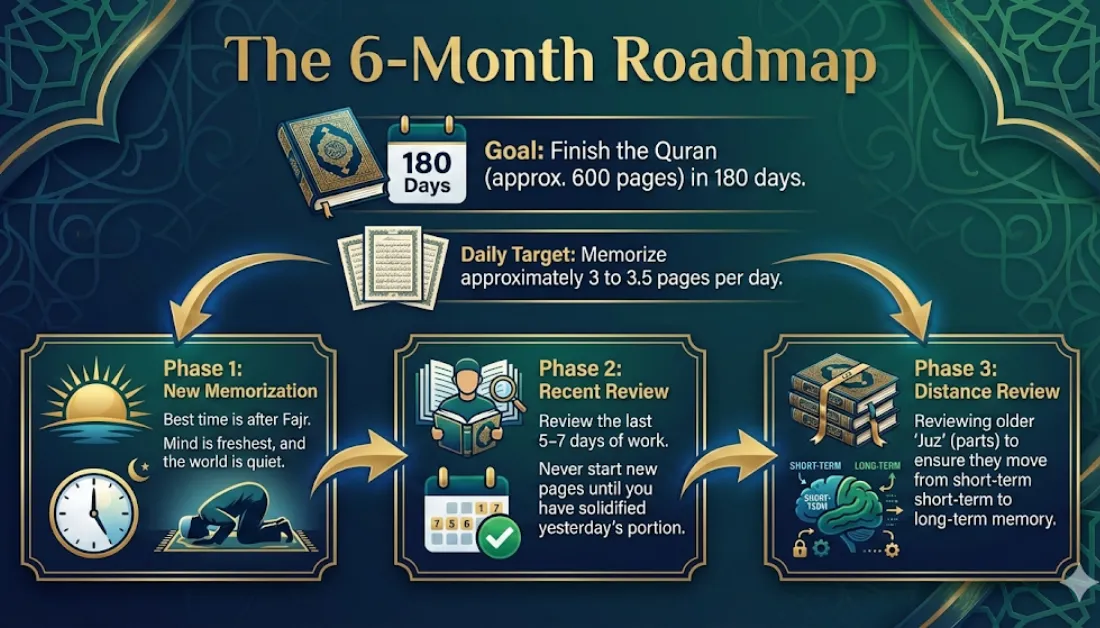
To finish the Quran (roughly 600 pages) in 180 days, you must memorize approximately 3 to 3.5 pages per day.
Phase 1: New Memorization
The best time for new memorization is after Fajr, when the mind is freshest, and the world is quiet.
Phase 2: Recent Review
This involves reviewing the last 5–7 days of work. Never start new pages until you have solidified yesterday’s portion.
Phase 3: Distance Review
Reviewing older “Juz” (parts) to ensure they move from short-term to long-term memory.
Achieve Your Dream of Memorizing the Holy Quran!
Get a customized memorization plan and 1-on-1 guidance from expert Azhari tutors.
Effective Techniques to hifz Quran in 6-months
To ensure students complete your Hifz in just six months, you cannot rely on rote rehearsal alone. Students need high-efficiency quran memorization techniques that engage their visual, auditory, and cognitive memory.
1. The “10-10-10” Visual Mapping
This technique helps build a “photographic” memory of the page.
- 10 Times Looking: Recite the verse slowly while looking at the text, focusing on the beginning and end of the verse.
- 10 Times From Memory: Close your eyes and recite it. If you stumble, look back briefly, then restart the count.
- 10 Times Connecting: Once students learn the next verse, recite the previous one and the new one together 10 times to “stitch” them together.
2. The Audio-Visual Technique
Attempting to memorize a page is often inefficient because your brain has to work twice as hard to decode the words and the rhythm simultaneously. To solve this, listen to a world-class reciter like Sheikh Al-Husary or Sheikh Minshawi recite your target pages five to seven times before you go to sleep.
This practice allows your mind to process the correct pronunciation and flow of the verses while you rest. When you wake up for your Fajr session, the material will already feel familiar, which significantly reduces the time it takes to commit the text to memory and helps prevent mistakes in your recitation.
3. Use of “Mutashabihat” (Similar Verses)
As you progress through your six-month sprint, you will frequently encounter Mutashabihat. These “look-alike” verses can often lead to confusion or “mental loops” if not handled systematically. To master them, maintain a dedicated notebook to document these pairs side-by-side, using a pencil to circle the specific word that makes each one unique.
By creating logical “mental anchors”, such as associating a specific word choice with the name or theme of the Surah, you move from passive muscle memory to active cognitive recall. Identifying these subtle distinctions early acts as a mental “speed bump,” preventing your tongue from accidentally sliding into a different chapter and ensuring your memorization remains precise and distinct.
4. The “Prayer Recitation” Method
The best way to “lock” your daily 3.5 pages into long-term memory is to recite them during your Sunnah and Nafl prayers. Use the first page in the Sunnah of Dhuhr, the second in the Sunnah of Maghrib, and the third in Tahajjud. Reciting under the pressure of prayer ensures that you truly know the portion by heart.
5. Writing the Verses (The Slate Method)
If you hit a “mental block” with a specific page, write it down. Writing engages kinesthetic memory. Use a whiteboard or a piece of paper to write the first letter of every word in a verse. This acts as a prompt that forces your brain to recall the full word without reading it.
Schedules for Hifz in Six Months
The Full-Time Student Schedule
Here is the breakdown of the Full-Time Student Schedule converted into a detailed descriptive format. This path is designed for those who can treat their memorization like a full-time job. If you have cleared your schedule of work or school commitments, your day should revolve entirely around the Quranic hours. This quran memorization schedule prioritizes the “Golden Hours” of the early morning.
Quran Sheikh Academy provides different schedules for a 6-month hifz of the Quran.
1. The Early Morning Sprint (05:00 AM – 07:30 AM)
Immediately following the Fajr prayer, you will tackle your Primary Hifdh. This is the most critical window of the day because the mind is at its peak retention capacity. During this block, your goal is to memorize 2 full pages.
- Method: Focus on one page at a time. Do not move to the second page until the first is solid enough to recite without looking once.
2. The Mid-Morning Push (08:00 AM – 09:30 AM)
After a short break or breakfast, return for your Secondary Hifdh. Here, you will memorize the remaining 1 to 1.5 pages required for your daily quota. Because you have already completed the bulk of the work, use this time to perfect the flow between the pages memorized earlier and these new ones.
3. The Mid-Day Consolidation (11:00 AM – 01:00 PM)
Before the Dhuhr prayer, focus on the Recent Review. It is a common mistake to only focus on “new” pages. In this session, you must recite the last 10 pages you memorized (your work from the previous few days) entirely from memory. This prevents the “fast-in, fast-out” effect of rapid memorization.
4. The Afternoon Deep Review (02:00 PM – 04:00 PM)
Post-Dhuhr or after Asr is the time for Distance Review (Manzil). This is where you revisit older portions of the Quran (the Juz/Paras you finished weeks ago). You should aim to review half to one full Juz during this time. Since these parts are already in your long-term memory, this session is about maintaining “smoothness” and catching any forgotten links.
5. Nightly Preparation (Before Bed)
Before you sleep, spend 15–20 minutes doing Previewing. Read the 3.5 pages you plan to memorize tomorrow at least 10 times while looking at the text. This “primes” your brain so that when you wake up at Fajr, the verses already feel familiar, cutting your memorization time in half.
The Split-Shift Schedule
Best for those who prefer breaking the work into smaller, high-intensity bursts throughout the day.
- After Fajr (2 Hours)
Memorize 1.5 pages. This is your most productive window.
- Lunch Break / Mid-day (1 Hour):
Memorize 1 page.
- After Asr (1.5 Hours):
Review the last 5 days of work.
- After Maghrib/Isha (2 Hours):
Memorize the final 1 page and review 1/2 Juz of old material.
In the online Hifz classes at Quran Sheikh, the qualified and certified tutors use multiple schedules that suit the needs and pace of the students. They also employ different hifz methods for optimal results.
Conclusion
Memorizing the Quran in six months is a goal, not just to finish, but to retain. If you find the pace too fast, it is better to extend your timeline to nine or twelve months than to memorize and lose the verses later. Look for the help of a professional hifz teacher for good results.
Common Questions About 6-Month Hifz
Is memorizing the Quran in 6 months realistically possible?
Yes, it is absolutely possible, but it requires an “Intensive Mode” mindset. This timeline is designed for students who can treat Hifz as their primary full-time job for this period. With a daily target of 3.5 to 4 pages and unwavering consistency, thousands of students achieve this milestone every year.
How many hours a day are required for this plan?
To succeed in 6 months, you need to dedicate 6 to 8 hours daily. This includes:
- 2-3 hours for new memorization (Sabaq) – ideally after Fajr.
- 2 hours for recent revision (Sabaq Para).
- 2 hours for cumulative revision (Manzil).
How to prevent forgetting old pages while memorizing fast?
The secret is the “Double-Loop Revision” system. Never start new pages without reviewing yesterday’s lesson first. Additionally, you must cycle through your entire memorized portion (Manzil) once every 5-7 days. Without this strict revision cycle, fast memorization often leads to fast forgetting.
Can I follow this schedule if I work or study full-time?
Honest answer: It is very difficult. The 6-month plan demands mental energy equivalent to a full-time job. If you have work or university commitments, we highly recommend our 1-Year Hifz Program instead, which offers a more balanced pace (1-2 pages/day) suitable for busy schedules.